Theme Guide: Po-Koro (BCOT)

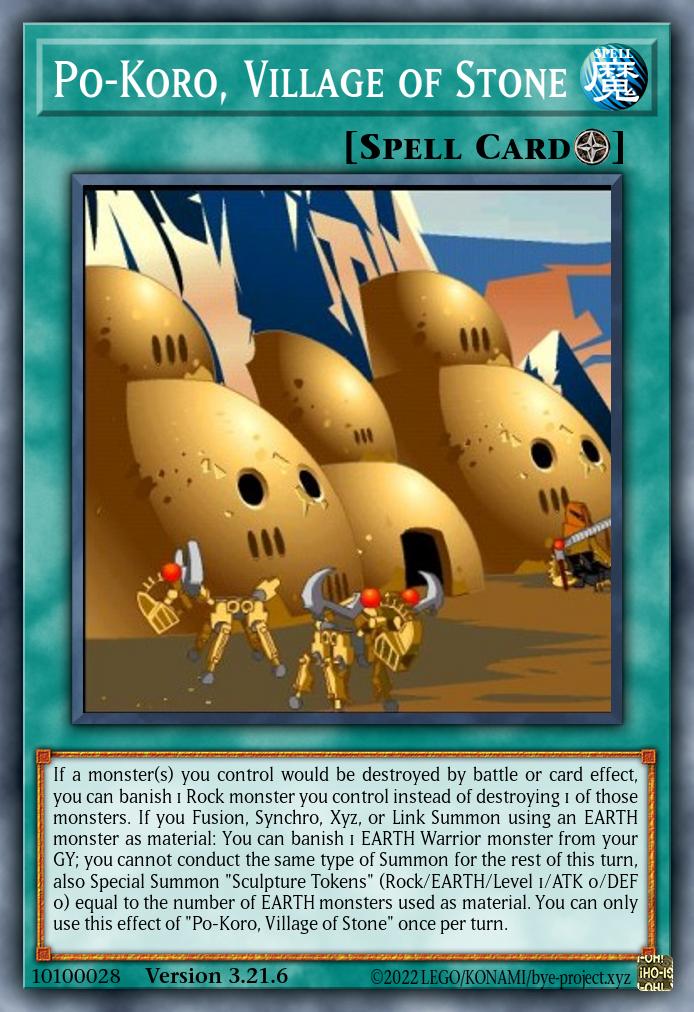
Po-Koro, Village of Stone

Field Spell

If a monster(s) you control would be destroyed by battle or card effect, you can banish 1 Rock monster you control instead of destroying 1 of those monsters. If you Fusion, Synchro, Xyz, or Link Summon using an EARTH monster as material: You can banish 1 EARTH Warrior monster from your GY; you cannot conduct the same type of Summon for the rest of this turn, also Special Summon “Sculpture Tokens” (Rock/EARTH/Level 1/ATK 0/DEF 0) equal to the number of EARTH monsters used as material. You can only use this effect of “Po-Koro, Village of Stone” once per turn.
Bionicle: Coming of the Toa (v3.21.6)

Among the villages on Mata Nui, I’d say Po-Koro is pretty high up there in terms of memorable traits. There’s the sculptures made by the resident carvers, the busy trading going on at the bazaar, the entire sport of Koli, and of course that little plague it suffered under in MNOG. For my particular depiction of the Village of Stone, I chose to focus on the first two of these: Trading and carving. (Koli is something I plan to study in more detail when it transforms into Kolhii later down the line, since it gets much more focus in the story then, and the plague is a topic for BCOR.)
Let’s begin dissecting from the second effect, since that will usually be the first you use. This one represents carving, and what it does is, like most Koro stuff, mainly inspired by the corresponding MNOG2 principle. In Po-Koro’s case, that means “Creation”. My first association with this in game terms has alway been the various Extra Deck summons (literally putting your monsters together to CREATE a new one), but upon further reflection I realized that there is one mechanic that creates stuff more literally than any other, and that is Tokens – those straight up don’t exist in any form until an effect says they do. So by combining those two ideas, I ended up with an effect that summons Tokens whenever you Special Summon from the Extra Deck.

“But isn’t that basically just Linkross for every summoning method?”, you might ask, and you wouldn’t be exactly wrong. However, there are some extra hoops to jump through here that hopefully fix the glaring balance issues with the concept. Most trivially, this card is in the Main and not the Extra Deck, so it’s already less consistently accessible by default. Then there are also two points that prevent using it too generically: You need to banish an EARTH Warrior (the “sculptor”) from the GY as cost, and you only get Tokens (the “sculptures”) up to the number of EARTH materials (the “raw materials”) in the summon. Note especially the banishing, which is meant to directly discourage mixing the Po-Koro strategy with Onu-Koro (where the resource loop relies on not getting your monsters banished). They both revolve around the EARTH attribute since Stone doesn’t exist separately in Yugioh, so I made sure to strongly distinguish them by playstyles instead. The final restriction meant to prevent Linkross-tier combos even in those decks that can make Po-Koro work is that whichever summoning method you use to trigger it becomes entirely locked for the rest of the turn (as opposed to just restricting how the Tokens are used). So the moment you make your Tokens, you need to be ready to pivot to something else. In MNOG2 terms, this sensitive issue of timing matches up quite well to the Kolhii skill of Strategy that is derived from Creation. I was quite cautious making this effect since it’s so close to a recently banned card, and initially it was even more restricted, but test runs suggest the current level of power should be fine without causing any notable problems. As usual, feel free to prove me wrong.

The secondary effect (which is listed first because that seems to be the convention for continuous vs activated effects) allows you to save your monsters from destruction by “trading” fancy Rocks, as they do on the Po-Koro bazaar. This is possibly not the best trade since you have to go as far as banishing a monster to protect another, but the Tokens made by the other effect are conveniently Rocks and in their case banishing is no different from destroying, so the idea is to mainly use those. One pesky detail I only noticed after implementing the effect is that it does not protect from full boardwipes because you can’t banish a card already marked for destruction as replacement, but it’s still fairly handy regardless.

If you compare to the other Koro field spells, you might notice that this one is much less xenophobic: You need to play EARTH monsters, including at least one EARTH Warrior, to make it work, but it doesn’t punish you for playing anything else. This is because, in the name of creation and creativity, I wanted to leave it possible to put whatever you want into the Extra Deck, as long as you’re using at least two different summoning methods.

Those were some long-ass design notes, but to summarize and boil the strategy down to its essence: The idea of a Po-Koro deck is simply to spam as much as possible from the Extra Deck, building a board while combining at least two different summoning methods, and any Tokens left at the end of that can act as additional protection.

As usual, the village itself is only part of the equation here, so on to the rest. For example, what could you summon from the Extra Deck to make especially good use of Po-Koro’s effect?

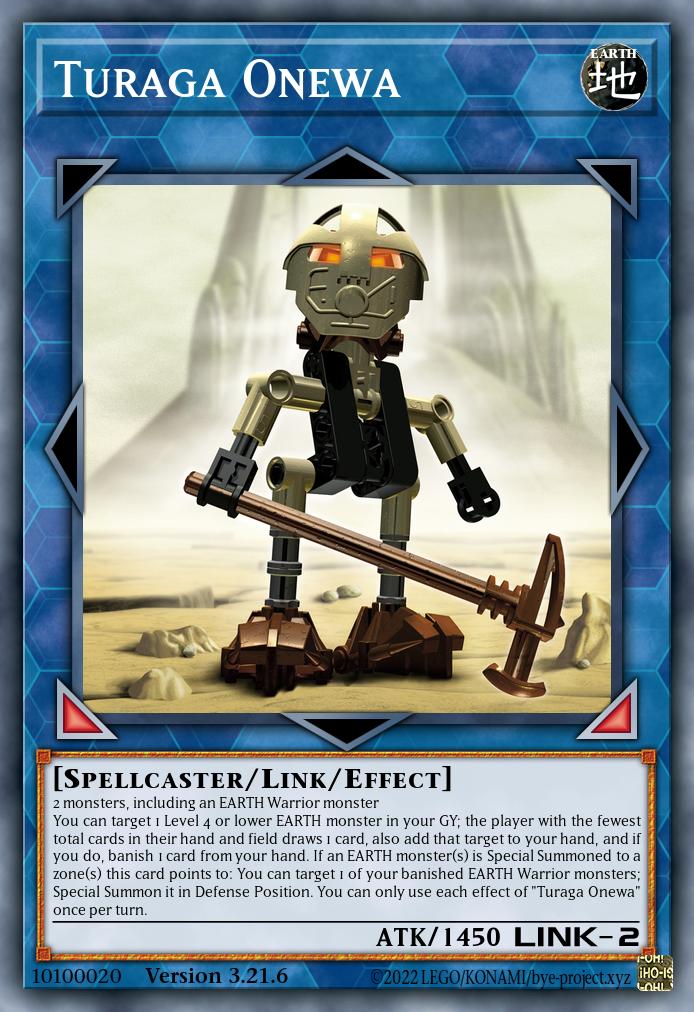
Turaga Onewa

Link Effect MonsterLink-2 [↙ ↘] | EARTH Spellcaster | ATK 1450

2 monsters, including an EARTH Warrior monster
You can target 1 Level 4 or lower EARTH monster in your GY; the player with the fewest total cards in their hand and field draws 1 card, also add that target to your hand, and if you do, banish 1 card from your hand. If an EARTH monster(s) is Special Summoned to a zone(s) this card points to: You can target 1 of your banished EARTH Warrior monsters; Special Summon it in Defense Position. You can only use each effect of “Turaga Onewa” once per turn.

Bionicle: Coming of the Toa (v3.21.6)

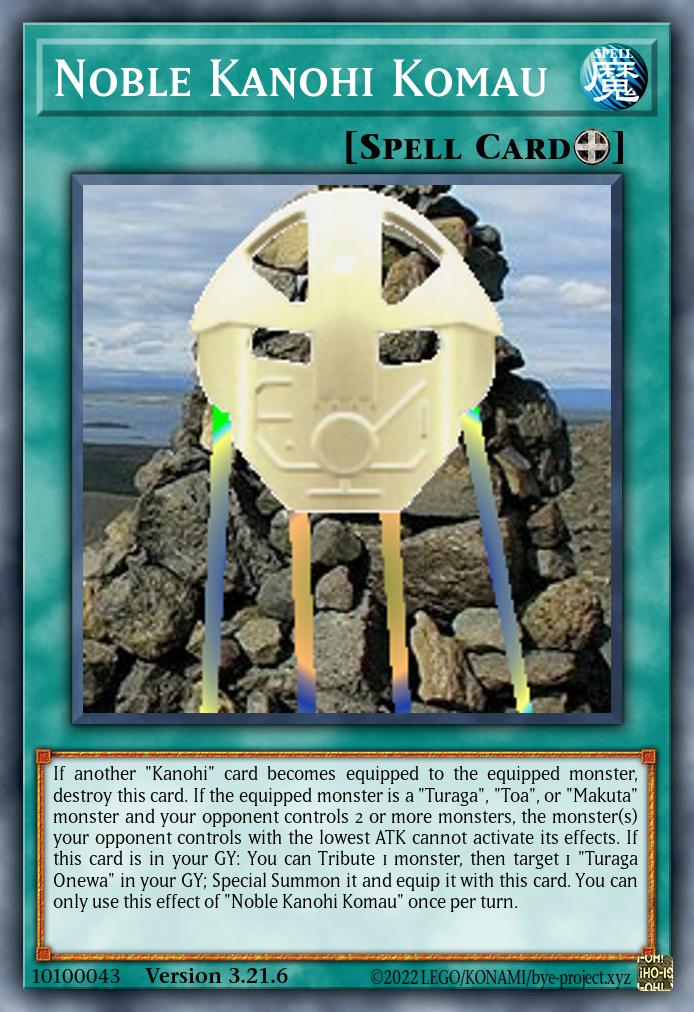
Noble Kanohi Komau

Equip Spell

If another “Kanohi” card becomes equipped to the equipped monster, destroy this card. If the equipped monster is a “Turaga”, “Toa”, or “Makuta” monster and your opponent controls 2 or more monsters, the monster(s) your opponent controls with the lowest ATK cannot activate its effects. If this card is in your GY: You can Tribute 1 monster, then target 1 “Turaga Onewa” in your GY; Special Summon it and equip it with this card. You can only use this effect of “Noble Kanohi Komau” once per turn.

Bionicle: Coming of the Toa (v3.21.6)

Turaga Onewa is meant to be one answer to this question. On having an EARTH monster summoned next to his arrow, he will immediately bring back a banished EARTH Warrior, which transforms the cost to summon Tokens into one more monster on the field. Of course, the summoning restriction means you can’t use all this field presence to just continue Link Summoning, so you’ll need to make sure you have a Tuner or something to really benefit here. One thing I considered doing for a bit was letting Onewa turn the monster he brings back into a Tuner, but what bothered me there was that it would potentially allow you to just use the same Gouki-based deck I had for Onu-Koro and still reliably fulfill the requirement of two Extra Deck summoning methods. Kind of runs counter to the separation I’m trying to achieve, although it would technically be a distinct strategy even if it uses the same cards as its vehicle.

Since you can’t always expect to draw Po-Koro and do the setup that way, Onewa’s first effect provides another way to banish stuff, and comes with a lore gimmick to its math representing his famous ability to resolve disputes fairly. On top of the perfectly neutral action of putting a monster from the GY back into the hand and banishing a card from the hand, it gives a draw to only the player who is currently behind in advantage, so it works out to +1 if that’s you and -1 if it’s your opponent (and neutral in every other case). Fair.

The Kanohi Komau has mind control as its power, and with the original version back in 2014, I was quick to make the obvious association and write an effect that takes control of an opponent’s monster. In hindsight, that’s a bit above the intended powerlevel of Noble Kanohi, so the redesign instead turns it into a passive effect of using mind control to “stun” the weakest enemy (in terms of ATK, because unfortunately there isn’t a willpower stat that could be used for perfect accuracy). This fits well with the Huna and Rau as an effect that just inconveniences the opponent a bit and forces them to play around it, and for Po-Koro’s particular strategy of building a board with Extra Deck monsters, it makes a reasonable addition to the usual negates and disruptions you want to set up. Tributing a Sculpture Token to revive Onewa together with the Komau is something that happened semi-frequently during testing.

One noteworthy aspect of the way Onewa brings back banished monsters is that they are free to use their effects, so we can gain further advantage by using targets with beneficial effects on Special Summon. This is the niche our first Po-Matoran plays into.

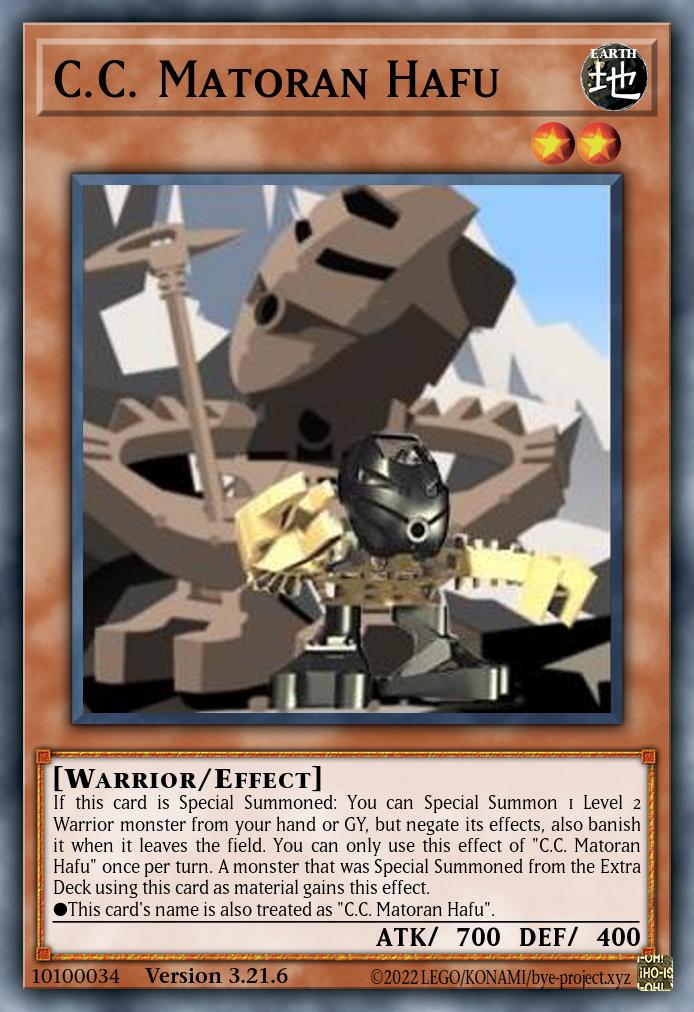
C.C. Matoran Hafu

Effect MonsterLevel 2 | EARTH Warrior | ATK 700 / DEF 400

If this card is Special Summoned: You can Special Summon 1 Level 2 Warrior monster from your hand or GY, but negate its effects, also banish it when it leaves the field. You can only use this effect of “C.C. Matoran Hafu” once per turn. A monster that was Special Summoned from the Extra Deck using this card as material gains this effect.
●This card’s name is also treated as “C.C. Matoran Hafu”.

Bionicle: Coming of the Toa (v3.21.6)

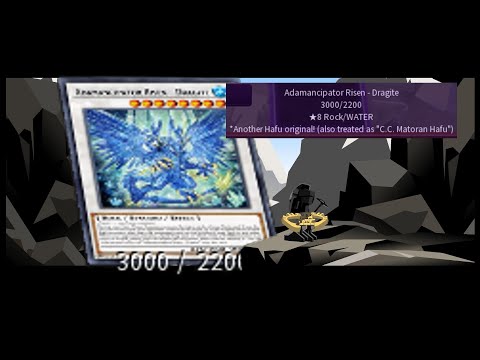
Both of Hafu’s effects are essentially retained from his original incarnation, with a bit of adjustment. Being the master carver, he’s fully meant to facilitate more Extra Deck summoning and brings back another Level 2 Warrior (could be another Matoran, or a generic Tuner like Junk Anchor to enable Synchros) when Special Summoned. His other ability is crafting “Hafu originals” in his own likeness, meaning whatever uses him as material inherits his name. This mainly has applications in a dedicated “C.C. Matoran” strategy, where members of the archetype get a range of neat benefits. Here, it’s really just a cute gimmick that barely comes up.

The other thing about Onewa is that you need to Special Summon an EARTH monster to the correct zone so he triggers, which is also something the villagers can assist with.

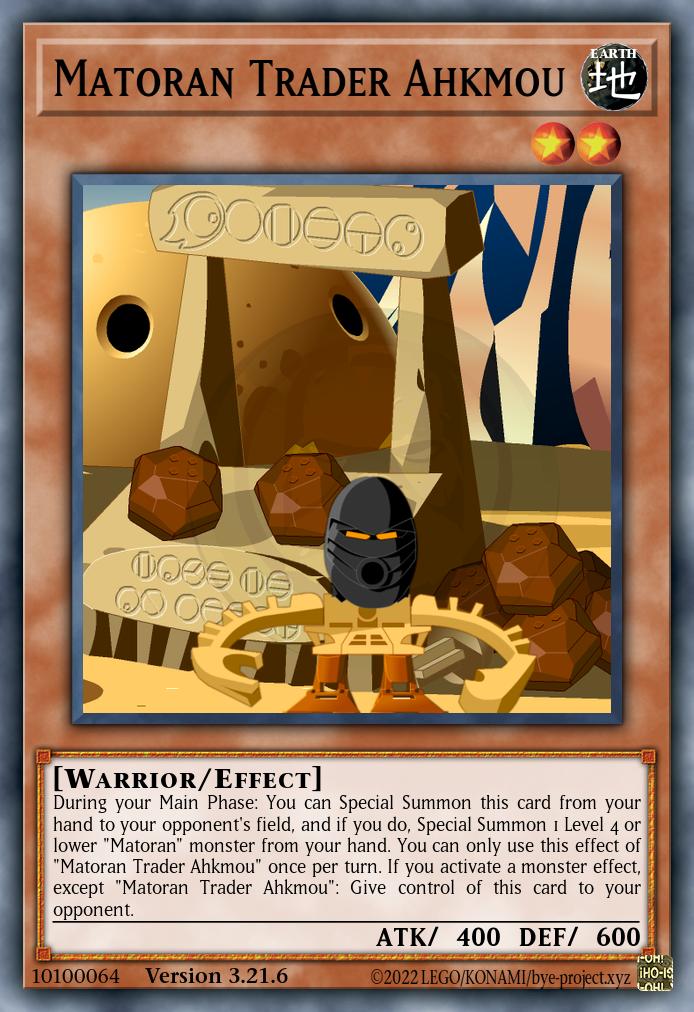
Matoran Trader Ahkmou

Effect MonsterLevel 2 | EARTH Warrior | ATK 400 / DEF 600

During your Main Phase: You can Special Summon this card from your hand to your opponent’s field, and if you do, Special Summon 1 Level 4 or lower “Matoran” monster from your hand. You can only use this effect of “Matoran Trader Ahkmou” once per turn. If you activate a monster effect, except “Matoran Trader Ahkmou”: Give control of this card to your opponent.

Bionicle: Coming of the Toa (v3.21.6)

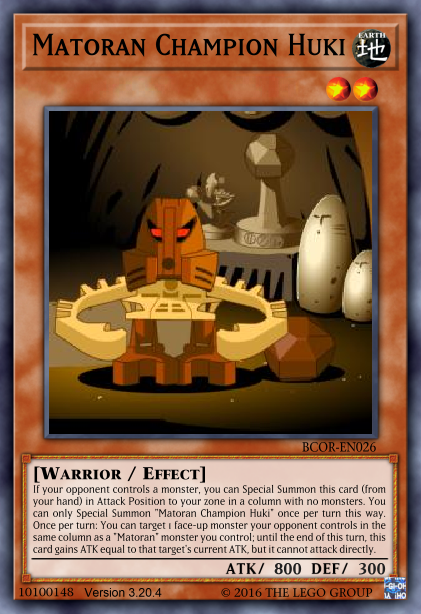
Matoran Champion Huki

Effect MonsterLevel 2 | EARTH Warrior | ATK 800 / DEF 300

If your opponent controls a monster, you can Special Summon this card (from your hand) in Attack Position to your zone in a column with no monsters. You can only Special Summon “Matoran Champion Huki” once per turn this way. Once per turn: You can target 1 face-up monster your opponent controls in the same column as a “Matoran” monster you control; until the end of this turn, this card gains ATK equal to that target’s current ATK, but it cannot attack directly.

Bionicle: Challenge of the Rahi (v3.20.4)

Ahkmou, the perfectly loyal and honest businessman who is definitely not in cahoots with evil or anything, puts himself on the opponent’s field from your hand to allow you a free Special Summon of a Matoran. Not only does this offer an additional way to start and extend combos, it also protects you from handtraps that require an empty field, which is further enhanced by his second effect to betray his current controller whenever they activate another monster effect (including pretty much all other handtraps). Just two things to note about this: It’s a trigger effect and thus won’t happen until after the chain with the monster effect has resolved, and it’s not once per turn in any way, so he might just betray you back right after joining your side.

Koli champion Huki is a very easy Special Summon going second, placing himself precisely in front of any open spots in your opponent’s lineup – ideally one of the two zones Onewa points to. Even going first, you can actually set up his Special Summon with Ahkmou, so that’s potentially neat. Furthermore, as a highly competitive pro athlete, he will rise to any challenge directly facing him or his fellow Matoran, gaining enough ATK to hit over any monster in the same column.

If you’re familiar with the structure of these Koro strategies, you already know that the last piece of the puzzle is the village’s Toa, but in the case of such an Extra Deck focused theme, a Main Deck boss is a bit of an odd fit. Still, I feel like I managed to give him an effect that provides a fair level of utility.

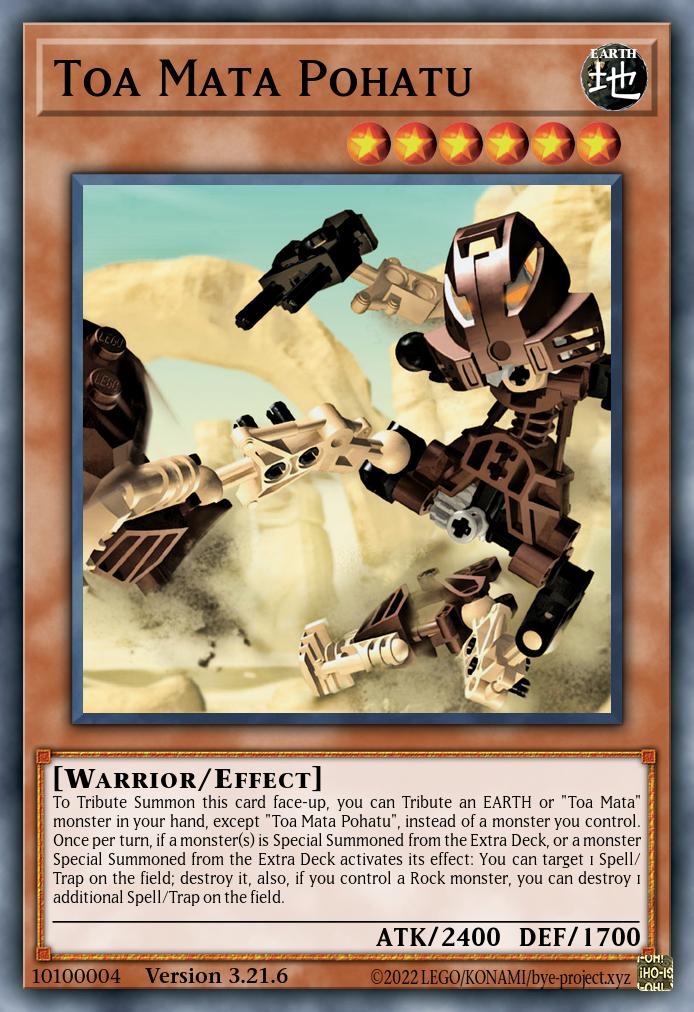
Toa Mata Pohatu

Effect MonsterLevel 6 | EARTH Warrior | ATK 2400 / DEF 1700

To Tribute Summon this card face-up, you can Tribute an EARTH or “Toa Mata” monster in your hand, except “Toa Mata Pohatu”, instead of a monster you control. Once per turn, if a monster(s) is Special Summoned from the Extra Deck, or a monster Special Summoned from the Extra Deck activates its effect: You can target 1 Spell/Trap on the field; destroy it, also, if you control a Rock monster, you can destroy 1 additional Spell/Trap on the field.

Bionicle: Coming of the Toa (v3.21.6)

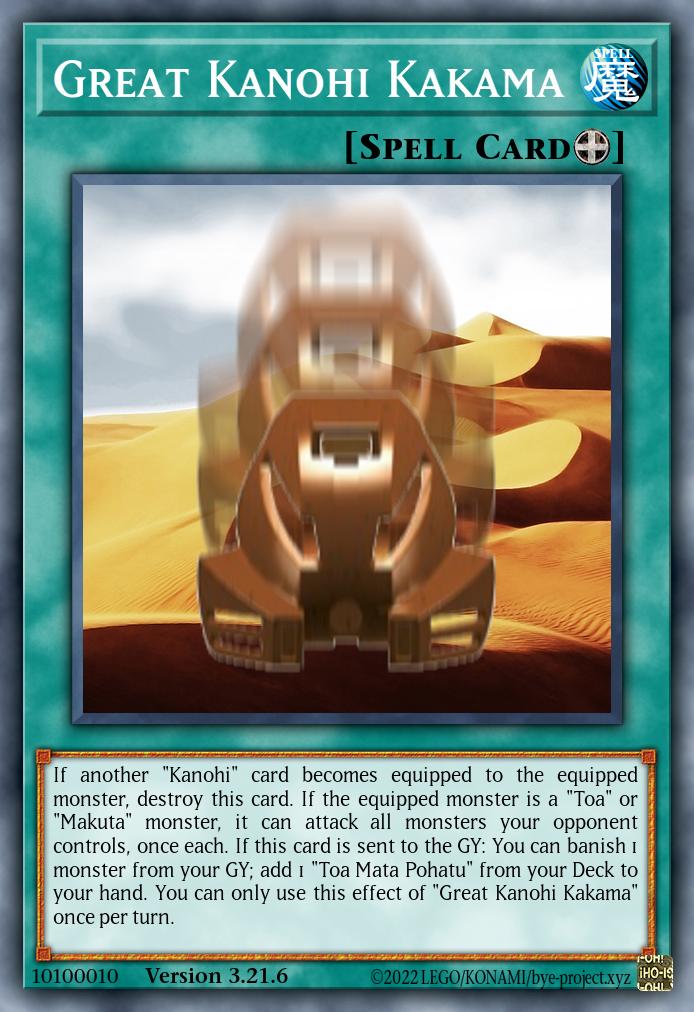
Great Kanohi Kakama

Equip Spell

If another “Kanohi” card becomes equipped to the equipped monster, destroy this card. If the equipped monster is a “Toa” or “Makuta” monster, it can attack all monsters your opponent controls, once each. If this card is sent to the GY: You can banish 1 monster from your GY; add 1 “Toa Mata Pohatu” from your Deck to your hand. You can only use this effect of “Great Kanohi Kakama” once per turn.

Bionicle: Coming of the Toa (v3.21.6)

What Pohatu brings to the table is Spell/Trap removal, and to match Po-Koro, he does it whenever monsters are Special Summoned from the Extra Deck. Furthermore, since we don’t want him to be useless after you have already built your board, he has a secondary trigger off the effect activations of Extra Deck monsters. Do note, however, that this is a trigger effect and not a quick effect, meaning it will activate on a separate chain only after the triggering effect has resolved.

The mental image behind this S/T destruction is destroying stuff by kicking a rock at it, and so it’s fitting to have a bonus effect if you actually happen to have a Rock monster (e.g. a Sculpture Token or a Suva). I went with the ricochet idea here, which means you get an additional (non-targeting) S/T destruction in that case. Seeing how the law of creative heroic thinking permits using the environment to harm enemies indirectly, letting the second destruction affect monsters as well may be a viable option, though in that case it would probably be fair to also destroy your Rock monster as a downside.

Finally, the Kanohi Kakama, Great Mask of Speed, lets the equipped monster move fast enough to attack everything in a single Battle Phase, essentially letting you use Pohatu to clear out all the monsters after using his effect to clear up to 2 backrow. This is a scenario that occured exactly 0 times during the test circuit, but hey, theoretically it sounds useful.

Sample Deck

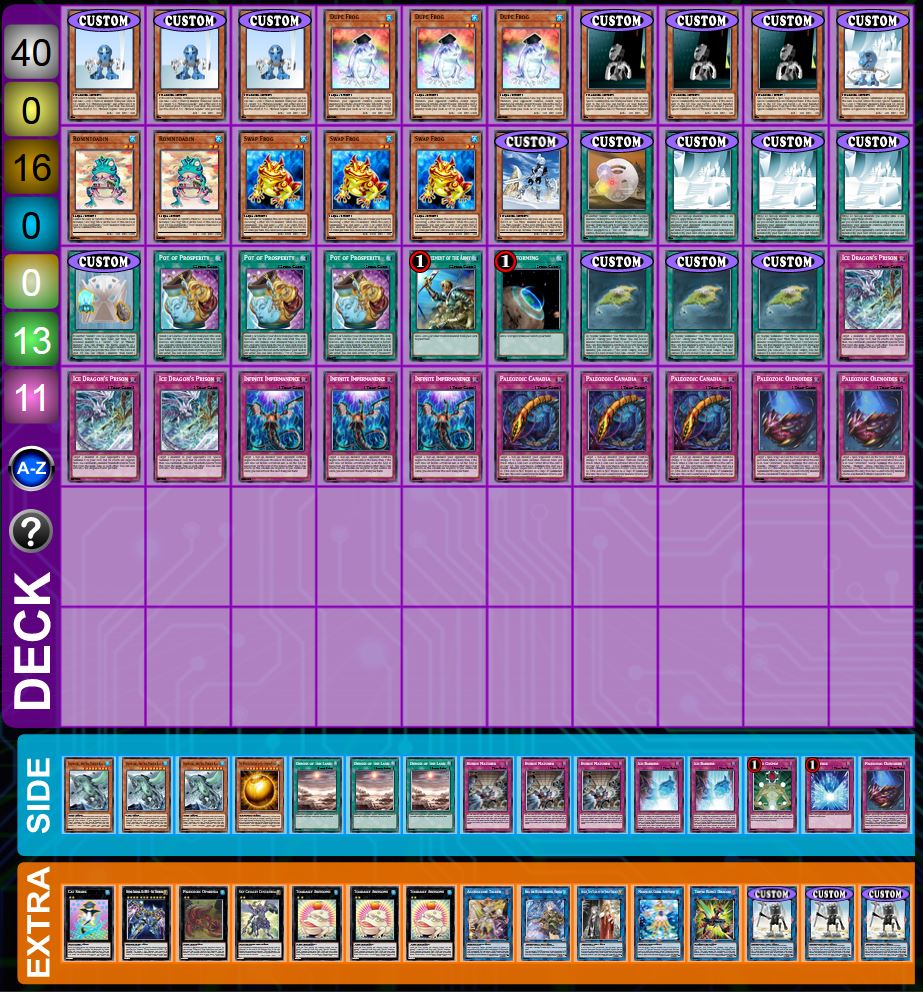
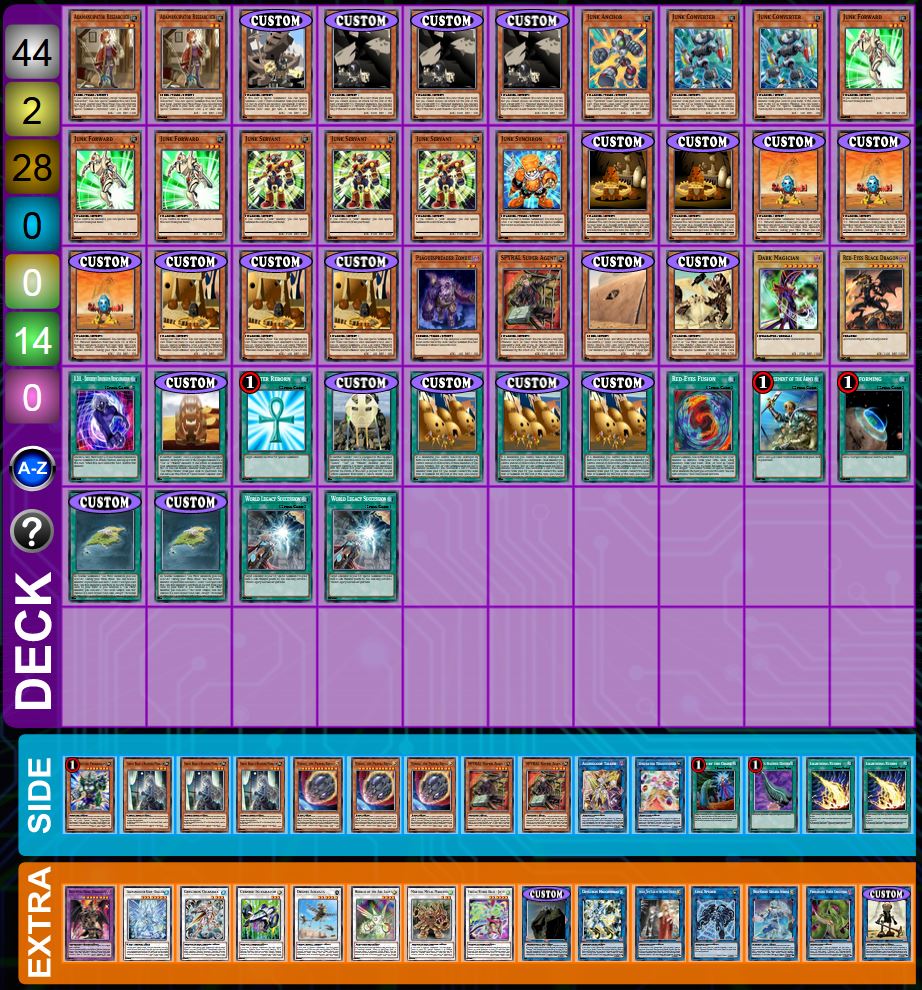
I couldn’t think of any existing EARTH Warrior archetype that focuses mainly on Extra Deck spam while also adhering to the rule of using 2+ summoning methods, so instead of using such a thing as a starting point I just had to jam some appropriate enginges together with Po-Matoran and hope it does what I want. Because of this, the sample deck explanation is a bit more elaborate than usual here.

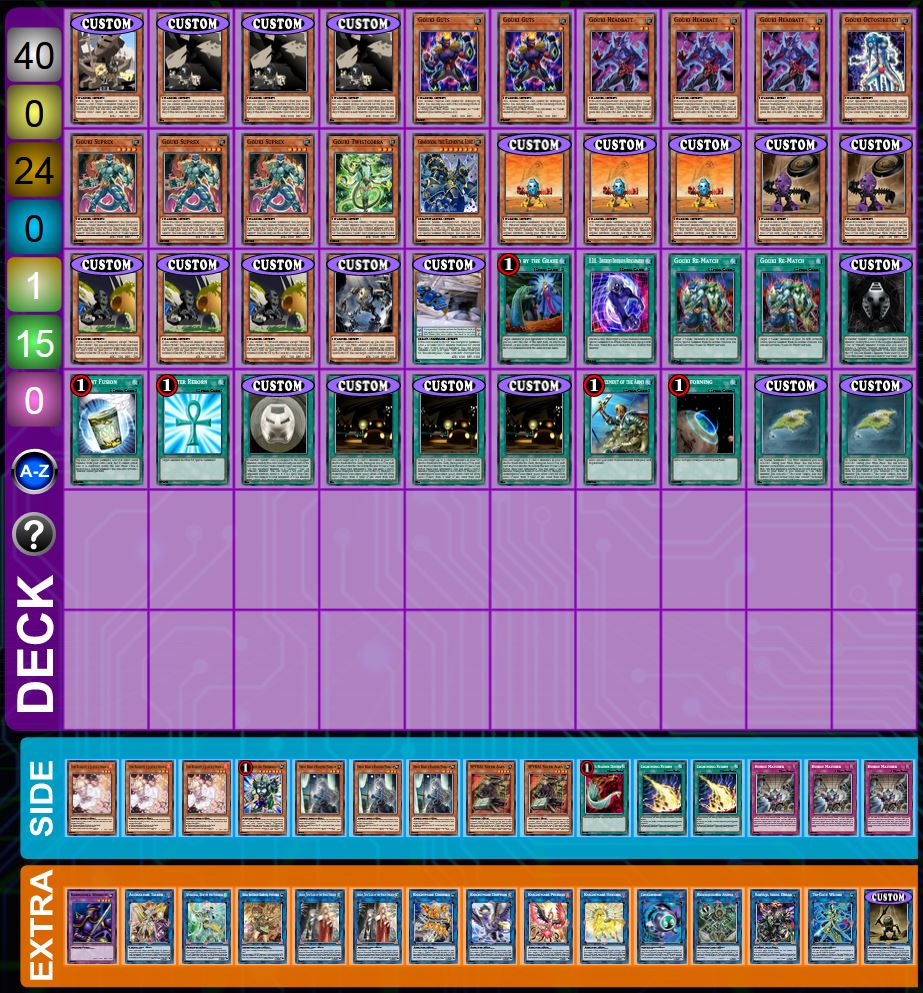
The route I took to fulfill the 2 summoning method requirement was Link + Synchro, since they’re much easier to pull off than Fusion and immediately put banishable monsters into the GY unlike Xyz. In order to get access to the necessary Tuners, I picked Junk monsters as the EARTH Warrior core: Forward as a free Special Summon to start making Onewa, Anchor as a Tuner that also happens to be a Level 2 Warrior for Hafu, Converter as another Level 2 Warrior who does both searching and setup for Synchron (who is unfortunately not EARTH, but still good), and Servant as a free Special Summon whenever I have any of the others out. For the actual Matoran, we have just one Hafu (he only triggers on Special Summon, so having him in the hand isn’t the greatest), three Taipu because free Special Summon going first (not a Po-Matoran, but since the Chronicler’s Company are meant to work together, I figured there was no way to avoid synergy through the shared attribute in this case), three Ahkmou for the same reason, and two Huki since he’s mainly good going second. Thanks to Taipu’s presence, Hafu’s name change actually matters occasionally, by still letting you attack with some of your monsters from the Extra Deck after you summoned Taipu. The remaining EARTH Warriors are one Super Agent as an unreliable Special Summon and potential Spell/Trap remover, and Pohatu as your main Spell/Trap remover, Kakama search target, and Suva enabler.

Additional Tuners to get us consistent Synchro access are Adamancipator Researcher, whose Special Summon from the hand is enabled by Po-Koro’s Tokens, and Plaguespreader Zombie because this deck has a few garnets we’d like to put back if we draw them.

The Spells can be quickly summarized as Kanohi, searchers, and ways to Special Summon to Onewa’s zone (most interestingly Word Legacy Succession, which does exactly that). And of course, we have the Dragoon package I put in to celebrate the complete freedom of Extra Deck choices and then proceeded to regret immensely because it’s so powerful and easy to make that it ends up distracting from the actual point of the Deck. Which is why I ended up intentionally siding it out for the rest of the match every time I won a duel during testing, even when I didn’t actually use it.

The Extra Deck could probably be filled a million different ways, but what I settled on after trying a lot of variations is:

  • Onewa to get free monsters.
  • Amaja-Nui to get additional Tokens by linking off Onewa.
  • Isolde to trigger the Kakama’s search and to get Hafu or Junk Anchor (either as followup to Onewa or as an alternative if you don’t have the setup to trigger him).
  • Halquifibrax because it has just as much synergy with Po-Koro as it did with Linkross.
  • Desert Locusts to summon via Halq for a discard while potentially triggering Onewa.
  • Link Spider because it can be made with a single Sculpture Token.
  • Avramax as a big dude you can make e.g. with Onewa and Isolde.
  • Herald of the Arc Light as an easy banishing floodgate and negate.
  • Jiujiu as an indestructible removal tool.
  • Marcher and Integrator so you can get to Jiujiu from Researcher and two Sculpture Tokens while drawing in the process.
  • Dragite as a negate and removal tool.
  • Quandax to make Dragite while getting a WATER into the GY so the negate is turned on.
  • Verte Anaconda plus Dragoon in case you mess up the actual combo but feel like winning anyway.

Finally, the side deck is just a pile of EARTH staples and cards that are really good in some situations, plus options to fill the Extra Deck slots left open when removing the Dragoon stuff (Accesscode as an alternate boss, Geonator Transverser as an alternate Link you can make with random monsters).

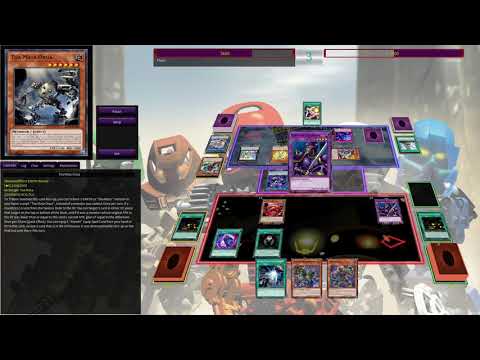
To see all this in action, continue right on.

Best of Test

Best of Test: Po-Koro (v3.15.5)

Conclusion

Po-Koro decks encourage Special Summoning from the Extra Deck and excel at providing a bunch of material to do so. However, lacking dedicated boss monsters of its own and having some tricky requirements and restrictions on the Field Spell, the success of the strategy is very much dependent on what other cards you combine it with, perhaps more so than any of the other villages. Also, the need to have cards to both make Onewa in the Extra Monster Zone and trigger him with an additional Special Summon can be quite the hurdle to consistency.

Theme Guide: Onu-Koro (BCOT)

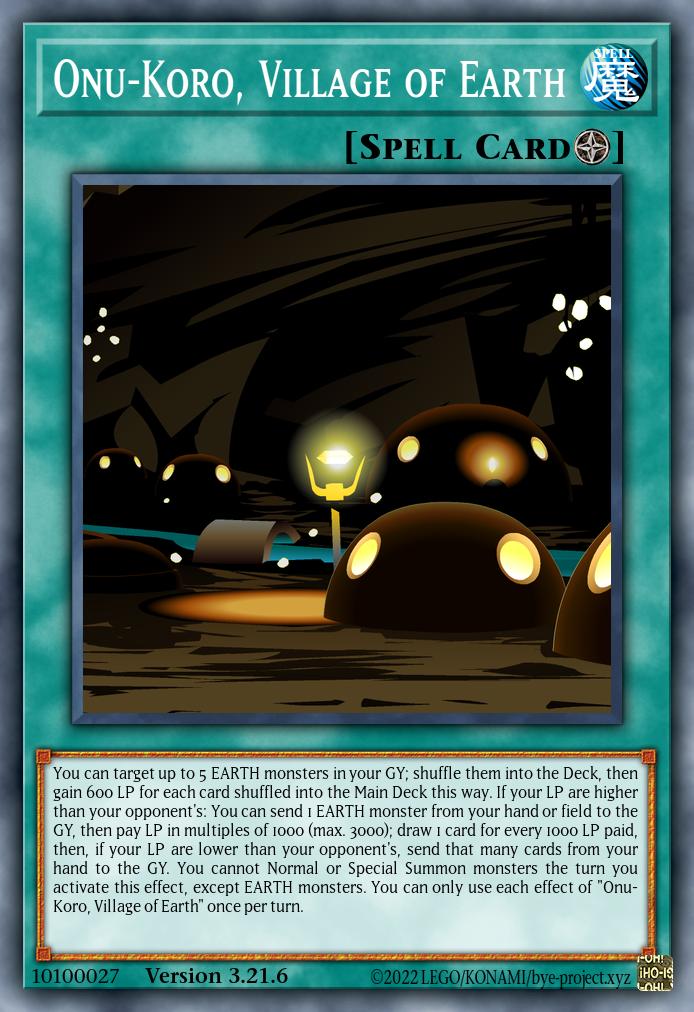
Onu-Koro, Village of Earth

Field Spell

You can target up to 5 EARTH monsters in your GY; shuffle them into the Deck, then gain 600 LP for each card shuffled into the Main Deck this way. If your LP are higher than your opponent’s: You can send 1 EARTH monster from your hand or field to the GY, then pay LP in multiples of 1000 (max. 3000); draw 1 card for every 1000 LP paid, then, if your LP are lower than your opponent’s, send that many cards from your hand to the GY. You cannot Normal or Special Summon monsters the turn you activate this effect, except EARTH monsters. You can only use each effect of “Onu-Koro, Village of Earth” once per turn.

Bionicle: Coming of the Toa (v3.21.6)

In the underground caverns of Onu-Koro, hard work is rewarded with great wealth, at least according to the Principle of Prosperity. For the effects of the Field Spell, I interpreted “hard work” as “putting monsters in the GY”, which is usually a pretty decent indication you’re doing things, and “wealth” as the resources of both LP and cards. So the first effect trades the proof of your work, the monsters in the GY, for wealth in the form of LP, and the second directly trades that amassed wealth for cards.

There are several extra balancing factors to the draw effect, given that it can potentially draw up to 3. First, it only works when you have higher LP, so you have to do some healing and/or damage before using it. Second, you need to send an EARTH monster from your hand or field to the GY, mainly to downgrade the level of advantage you get and to make the effect a bit more conditional, but also as setup for LP regeneration. Third, if you pay so much that you are now behind in LP, you lose an equal number of cards to what you drew, which technically works out to a -1 but is still fairly good since you can freely put anything from your hand into the GY. Fourth, it locks you into only summoning EARTH monsters for the whole turn, just to be extra sure it doesn’t get randomly abused. A proper Onu-Koro deck is mostly okay with this restriction anyway.

It follows that, as an Onu-Koro player, you want to establish a stable loop of putting EARTH monsters in the GY while building your board, shuffling them back to gain LP, and potentially drawing additional cards to further strengthen your position. Now we’ll take a look at how other cards contribute towards that goal.

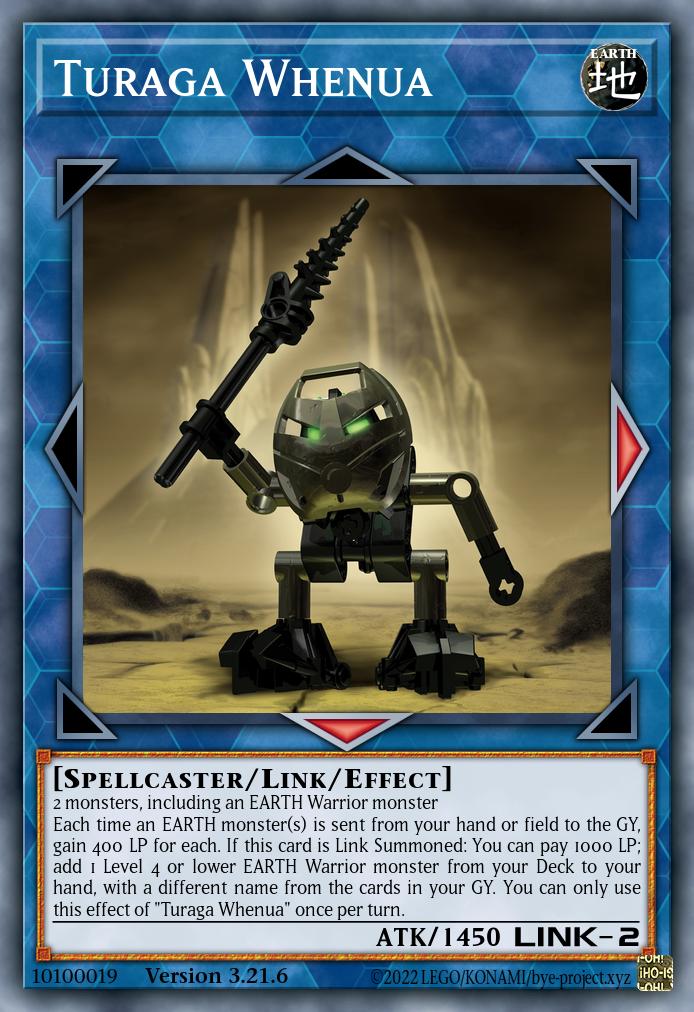
Turaga Whenua

Link Effect MonsterLink-2 [▼ ▶] | EARTH Spellcaster | ATK 1450

2 monsters, including an EARTH Warrior monster
Each time an EARTH monster(s) is sent from your hand or field to the GY, gain 400 LP for each. If this card is Link Summoned: You can pay 1000 LP; add 1 Level 4 or lower EARTH Warrior monster from your Deck to your hand, with a different name from the cards in your GY. You can only use this effect of “Turaga Whenua” once per turn.

Bionicle: Coming of the Toa (v3.21.6)

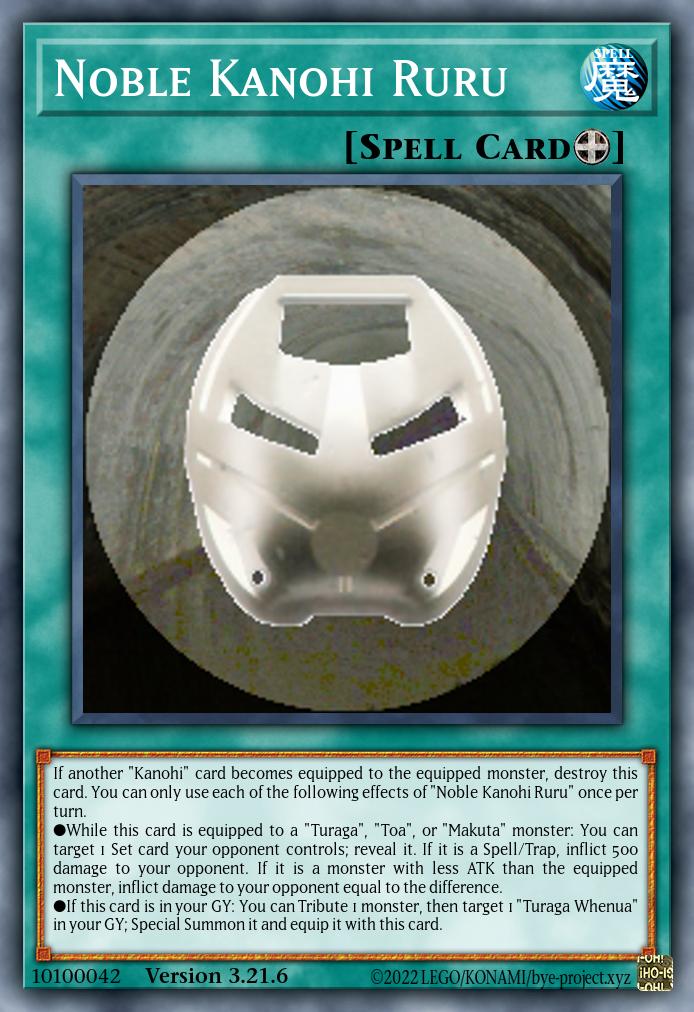
Noble Kanohi Ruru

Equip Spell

If another “Kanohi” card becomes equipped to the equipped monster, destroy this card. You can only use each of the following effects of “Noble Kanohi Ruru” once per turn.
●While this card is equipped to a “Turaga”, “Toa”, or “Makuta” monster: You can target 1 Set card your opponent controls; reveal it. If it is a Spell/Trap, inflict 500 damage to your opponent. If it is a monster with less ATK than the equipped monster, inflict damage to your opponent equal to the difference.
●If this card is in your GY: You can Tribute 1 monster, then target 1 “Turaga Whenua” in your GY; Special Summon it and equip it with this card.

Bionicle: Coming of the Toa (v3.21.6)

Whenua essentially acts as an overseer of the “work” you perform, providing small rewards in real time for every EARTH monster you put into the GY. On summon, he also helps you solve your current problems by learning from the mistakes of the past, or in non-lore terms, searches a low-level EARTH Warrior that isn’t in your GY yet. Of course, putting stuff back with Onu-Koro expands your search range here.

The Kanohi Ruru, Mask of Night Vision, doesn’t really have a main focus that synergizes with the Onu-Koro deck much – it just reveals Set cards, because that’s the mechanic that historically fits night vision best (for the record, hand reveals would be mind reading). It does also inflict some damage as a bonus, which could at least help achieve the necessary LP difference to use Onu-Koro to its full potential.

The search effect on Whenua is of course meant to fetch Onu-Matoran, and for that we have a few options.

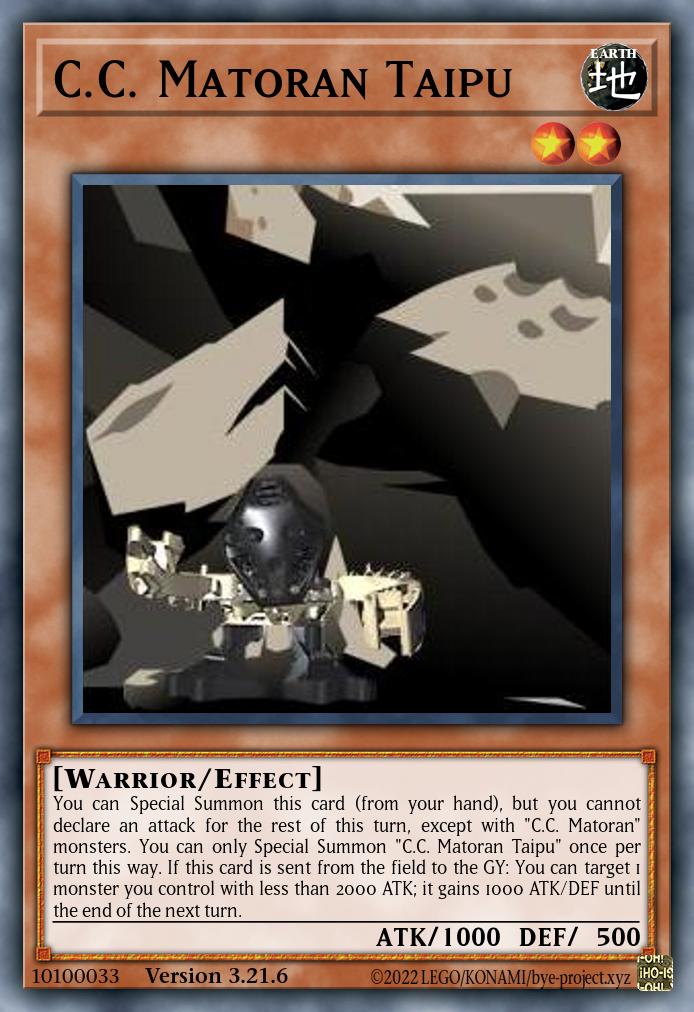
C.C. Matoran Taipu

Effect MonsterLevel 2 | EARTH Warrior | ATK 1000 / DEF 500

You can Special Summon this card (from your hand), but you cannot declare an attack for the rest of this turn, except with “C.C. Matoran” monsters. You can only Special Summon “C.C. Matoran Taipu” once per turn this way. If this card is sent from the field to the GY: You can target 1 monster you control with less than 2000 ATK; it gains 1000 ATK/DEF until the end of the next turn.

Bionicle: Coming of the Toa (v3.21.6)

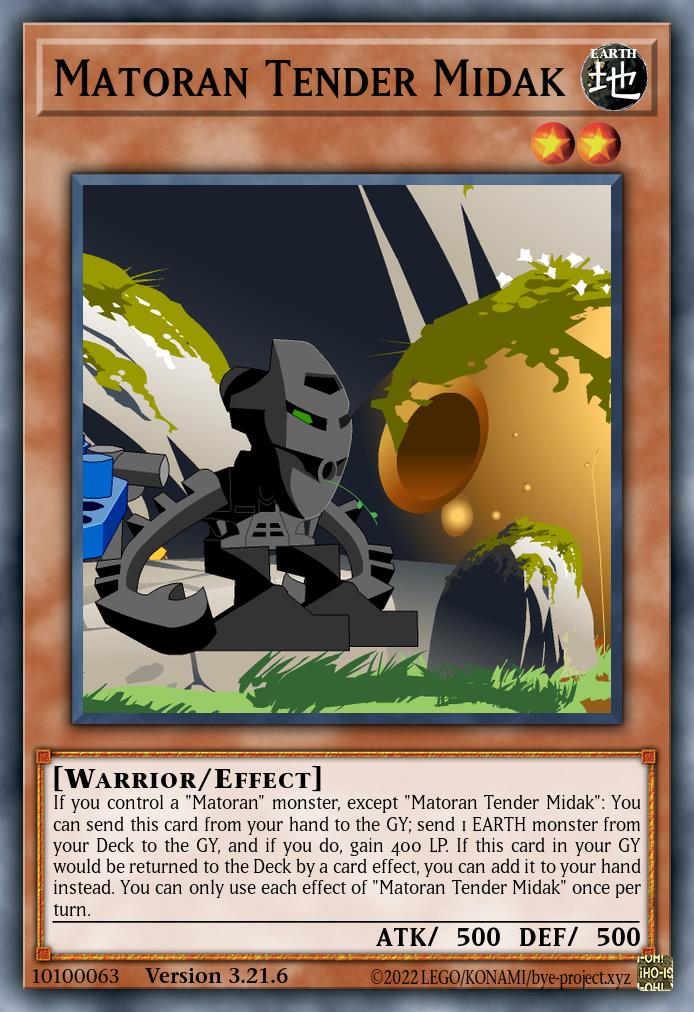
Matoran Tender Midak

Effect MonsterLevel 2 | EARTH Warrior | ATK 500 / DEF 500

If you control a “Matoran” monster, except “Matoran Tender Midak”: You can send this card from your hand to the GY; send 1 EARTH monster from your Deck to the GY, and if you do, gain 400 LP. If this card in your GY would be returned to the Deck by a card effect, you can add it to your hand instead. You can only use each effect of “Matoran Tender Midak” once per turn.

Bionicle: Coming of the Toa (v3.21.6)

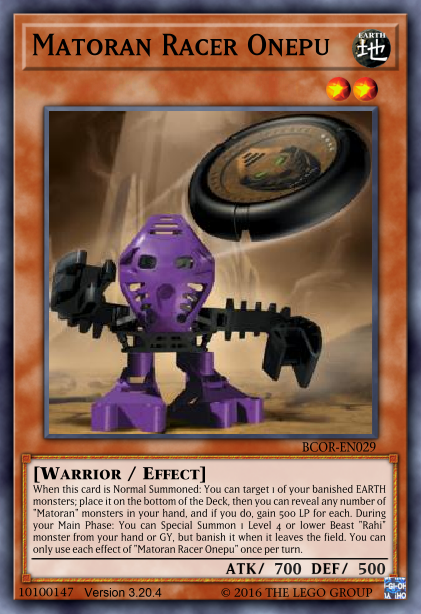
Matoran Racer Onepu

Effect MonsterLevel 2 | EARTH Warrior | ATK 700 / DEF 500

When this card is Normal Summoned: You can target 1 of your banished EARTH monsters; place it on the bottom of the Deck, then you can reveal any number of “Matoran” monsters in your hand, and if you do, gain 500 LP for each. During your Main Phase: You can Special Summon 1 Level 4 or lower Beast “Rahi” monster from your hand or GY, but banish it when it leaves the field. You can only use each effect of “Matoran Racer Onepu” once per turn.

Bionicle: Challenge of the Rahi (v3.20.4)

Taipu is most importantly a free Special Summon from the hand, assuming it is either turn 1 or Main Phase 2 – otherwise there’s an attack restriction that can trip you up sometimes, fitting for a somewhat clumsy Matoran who is always eager to help. Aside from these attributes, Taipu is also notable for his unusual physical strength, reflected in his unusually high ATK stat which matches the stat boost he gives another small monster when sent from field to GY. You can also use that for chain blocking.

Midak, the eccentric Onu-Matoran who likes sunlight and spends his time in a hut full of Ussals on the surface, is the first half of a little engine that takes advantage of the deck’s built in resource cycling. His role is sending an EARTH monster from your Deck to the GY (yes, can be anything, hence the restriction to needing a Matoran on the field) for setup and some immediate LP gain, and later returning directly to your hand when he would be shuffled back by Onu-Koro, because the Deck is too dark for his tastes.

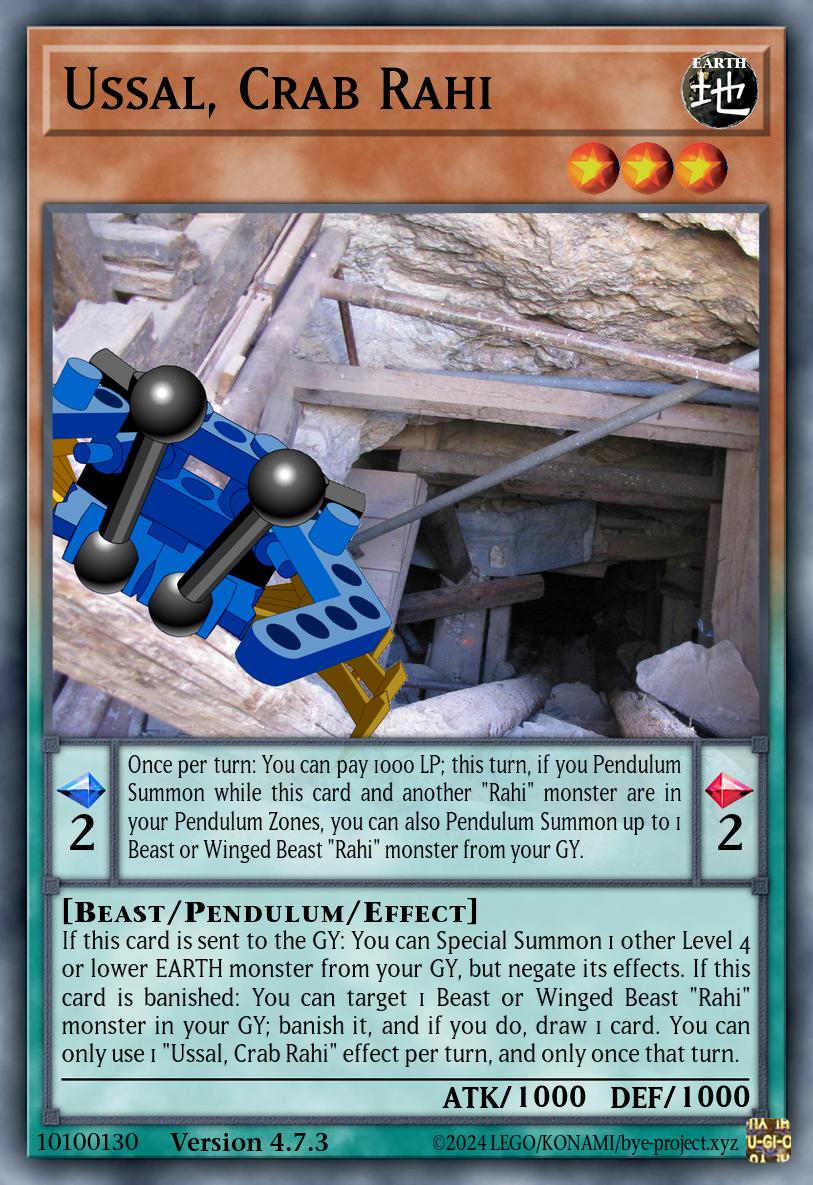
The second half of the combo is Onepu, the proud champion of the Ussal races. Having such a defining relationship with the crab Rahi, he actually interacts directly with it by Summoning it (or any other low-level Beast Rahi) from the GY. On Normal Summon, he can put a banished EARTH monster (such as an Ussal used in a previous iteration) back into your Deck and be rewarded with LP gain proportional to the size of his audience in your hand. So what exactly is the combo I’m talking about here? Well, the one missing key point is that the Ussal, a Level 4 EARTH Beast member of the Rahi archetype, can bring back another Level 4 or lower EARTH Beast monster from the GY when sent there.

Ussal, Crab Rahi

Pendulum Effect MonsterLevel 3 | Scale 2/2 | EARTH Beast | ATK 1000 / DEF 1000

[ Pendulum Effect ]
Once per turn: You can pay 1000 LP; this turn, if you Pendulum Summon while this card and another “Rahi” monster are in your Pendulum Zones, you can also Pendulum Summon up to 1 Beast or Winged Beast “Rahi” monster from your GY.
—————————————-
[ Monster Effect ]
If this card is sent to the GY: You can Special Summon 1 other Level 4 or lower EARTH monster from your GY, but negate its effects. If this card is banished: You can target 1 Beast or Winged Beast “Rahi” monster in your GY; banish it, and if you do, draw 1 card. You can only use 1 “Ussal, Crab Rahi” effect per turn, and only once that turn.

Bionicle: Challenge of the Rahi (v4.7.3)

What you do is this: Put Onepu on the field, activate Midak in your hand to send himself and an Ussal from the Deck to the GY, the Ussal triggers to bring back Midak, and with Onepu bringing back the Ussal you now have 3 monsters on the field. Do whatever combos you so desire from here, and once you’re done use Onu-Koro to shuffle back a bunch of EARTH monsters, including Midak who will instead come to your hand. Then on a subsequent turn you just need to find Onepu again, and due to him putting back the banished Ussal on Normal Summon everything is ready to go for another round.

A potential hole in our whole strategy of continuously shuffling monsters from the GY back to heal and draw is that we will eventually run out of Spells and Traps, as those are not recycled. It may not matter a lot of the time, but still, to our rescue comes the wise Toa of Earth.

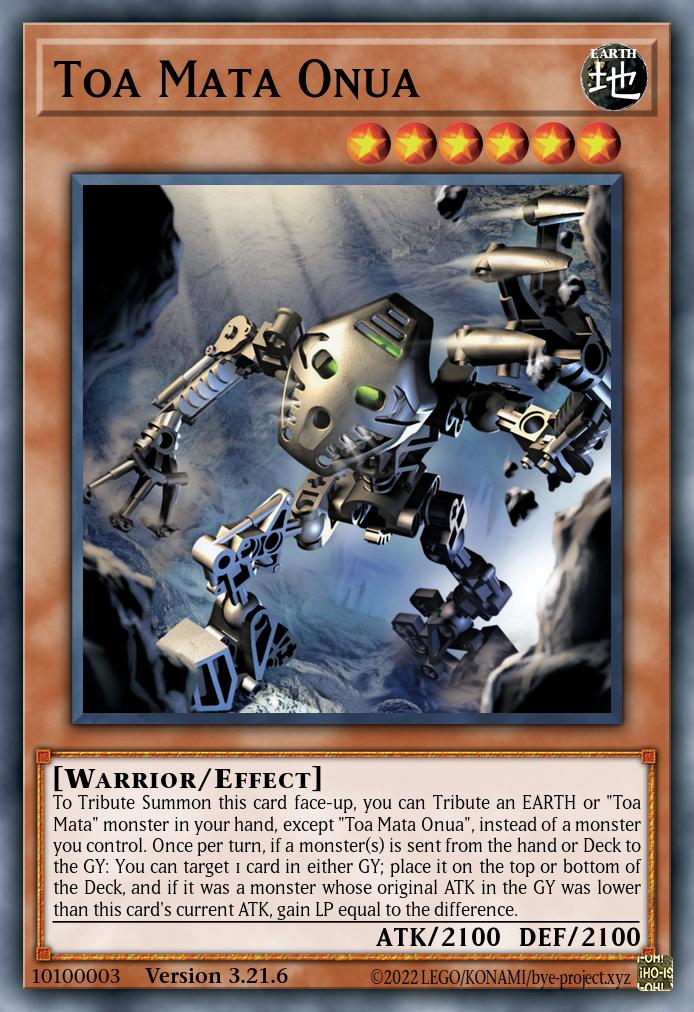
Toa Mata Onua

Effect MonsterLevel 6 | EARTH Warrior | ATK 2100 / DEF 2100

To Tribute Summon this card face-up, you can Tribute an EARTH or “Toa Mata” monster in your hand, except “Toa Mata Onua”, instead of a monster you control. Once per turn, if a monster(s) is sent from the hand or Deck to the GY: You can target 1 card in either GY; place it on the top or bottom of the Deck, and if it was a monster whose original ATK in the GY was lower than this card’s current ATK, gain LP equal to the difference.

Bionicle: Coming of the Toa (v3.21.6)

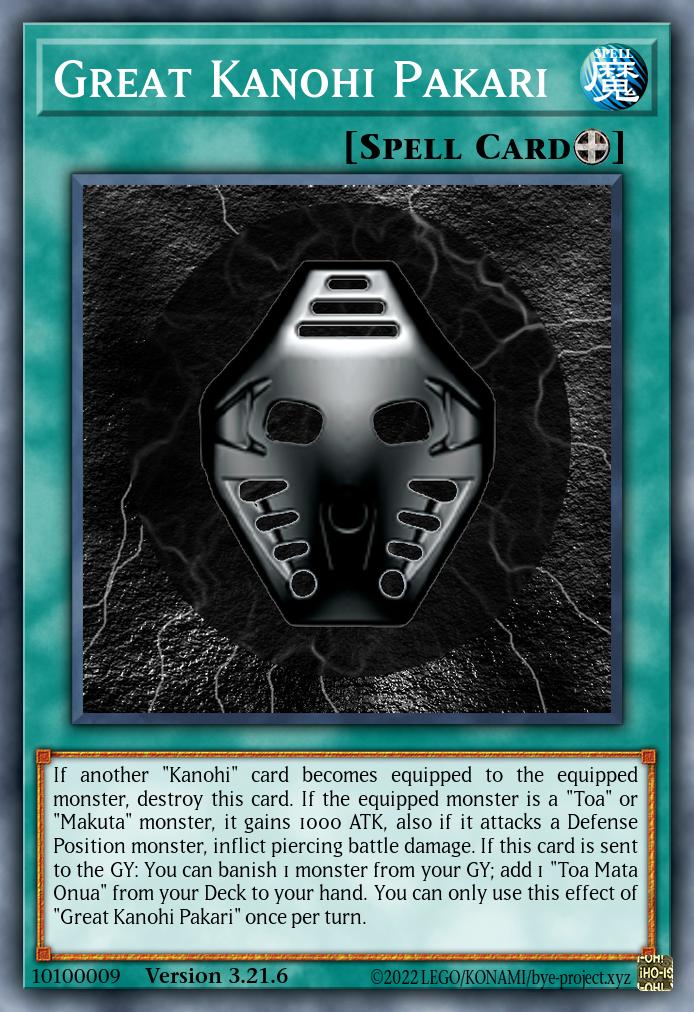
Great Kanohi Pakari

Equip Spell

If another “Kanohi” card becomes equipped to the equipped monster, destroy this card. If the equipped monster is a “Toa” or “Makuta” monster, it gains 1000 ATK, also if it attacks a Defense Position monster, inflict piercing battle damage. If this card is sent to the GY: You can banish 1 monster from your GY; add 1 “Toa Mata Onua” from your Deck to your hand. You can only use this effect of “Great Kanohi Pakari” once per turn.

Bionicle: Coming of the Toa (v3.21.6)

Indeed, Onua gives us the ability to return any card from the GY to the Deck, assuming the trigger of a monster being sent from hand or Deck to GY applies. And beyond simple recycling, he comes with the benefits of working on both GYs, being able to place the card either on top or bottom of the Deck, and healing you if you return a monster with lower ATK than him. This means he can put your own Spells/Traps just a draw away, place something dead on top of the opponent’s Deck, take something they just sent to the GY away before it can be used, or simply be used for LP regeneration to enable Onu-Koro.

The Kanohi Pakari, Great Mask of Strength, also plays into these LP games. The bonus ATK on Onua makes it so you stand to gain more LP from his effect, and a high-ATK piercer is a pretty reliable way to damage your opponent and help establish the desired LP difference.

Sample Deck

https://www.duelingbook.com/deck?id=6583242

Our goal is to do “work” – putting monsters from hand or field into the GY – as quickly as possible to get our LP and card advantage engine fueled, so this is basically a Link spam deck. In addition to our core engine of Taipu/Onepu/Midak/Ussal, the stars of this deck are the Goukis, which allow us to just keep throwing monsters onto the field while also refilling the hand with their own floating effects, supplementing the draws we get from Onu-Koro later in the game. Visiting the village are the Chronicler Takua and Po-Koro‘s Hafu, which together form yet another way to get out a total of up to three monsters off one card (though banishing the one Hafu summons is a little detrimental to our resource loop).

The ultimate payoffs going first are usually some combination of Knightmare Gryphon, Apollousa, and Tri-Gate Wizard, while going second the big power play is obviously Accesscode. Grandsoil is both a main deck boss and a combo piece that is very easy to use in this strategy, since you can easily control the number of EARTH monsters in your GY.

Best of Test

Best of Test: Onu-Koro

Conclusion

The greatest strength of Onu-Koro decks is the ability to replenish resources, both cards and LP, over and over again. Even if you can’t kill your opponent quickly, you can probably survive long enough to outlast them if things go reasonably well, though most of the time there isn’t a need to drag things out too much.

Theme Guide: Ga-Koro (BCOT)

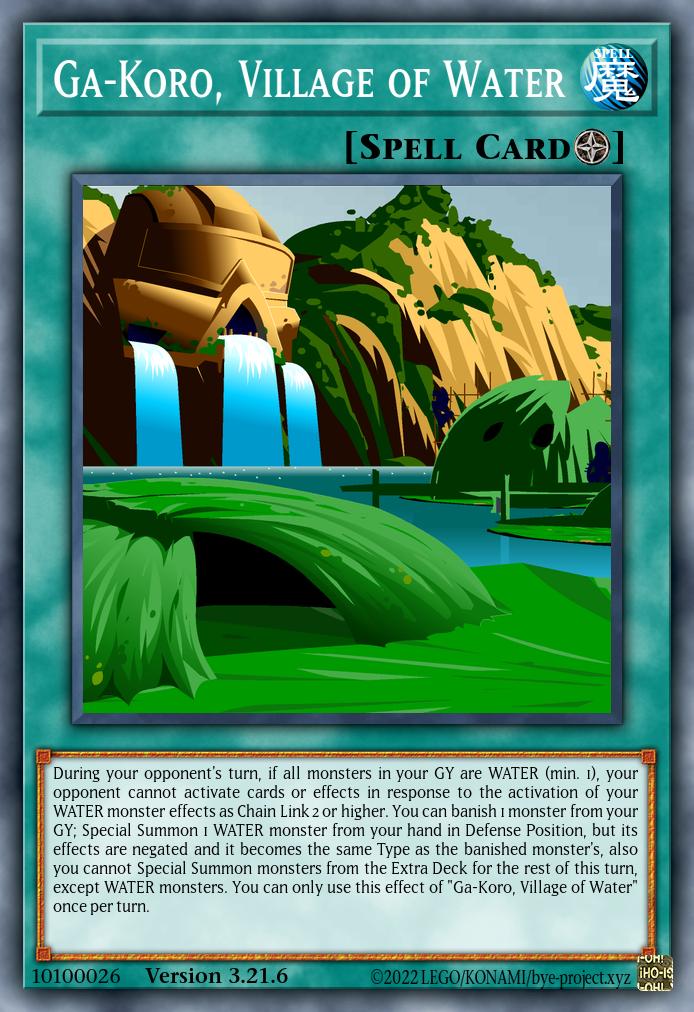
Ga-Koro, Village of Water

Field Spell

During your opponent’s turn, if all monsters in your GY are WATER (min. 1), your opponent cannot activate cards or effects in response to the activation of your WATER monster effects as Chain Link 2 or higher. You can banish 1 monster from your GY; Special Summon 1 WATER monster from your hand in Defense Position, but its effects are negated and it becomes the same Type as the banished monster’s, also you cannot Special Summon monsters from the Extra Deck for the rest of this turn, except WATER monsters. You can only use this effect of “Ga-Koro, Village of Water” once per turn.

Bionicle: Coming of the Toa (v3.21.6)

Ga-Koro is a beautiful village of leaf huts swimming on the waters of Naho Bay. According to Mata Nui Online Game 2, the central Principle of the Ga-Matoran is Purity, from which they derive Speed. How these concepts translate to card game mechanics was, at least to me, not entirely obvious at first glance, so let’s go over the design in detail.

Effect #1 preserves the purity of your plays by not letting your opponent corrupt them with any dirty responses, as long as your GY is filled purely with WATER monsters. To make this reasonably balanced, it has an additional restriction of only working on effects activated during the opponent’s turn as Chain Link 2 or higher – which usually means quick effects. Because speed, geddit? Incidentally, quick effects that can be used during the opponent’s turn are somewhat common among existing WATER monsters (e.g. Abyssalacia, Crocodragon, the entire Crystron archetype), so that provides ample deck building options.

Effect #2 grants speed in the form of tempo, specifically an extra summon of a WATER monster at the cost of banishing any monster from the GY (which conveniently helps with the setup for Effect #1). The purity aspect here is that it locks you into only summoning WATER monsters from the Extra Deck for the rest of the turn, as is appropriate with this kind of effect. Also, the Type of the summoned monster is changed to match the banished one, which was originally a trick to make up for the lack of WATER Warriors in the game, but is now mostly just another point of purity flavour after I added more Ga-Matoran.

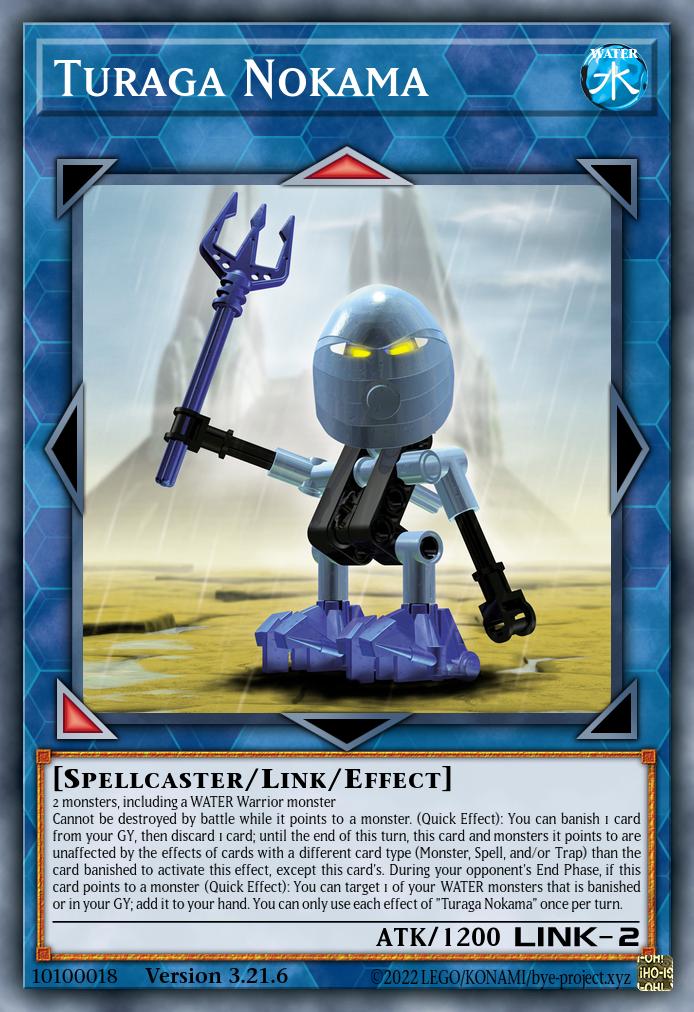
The reason we need specifically WATER Warriors is, of course, the village’s Turaga, Nokama.

Turaga Nokama

Link Effect MonsterLink-2 [▲ ↙] | WATER Spellcaster | ATK 1200

2 monsters, including a WATER Warrior monster
Cannot be destroyed by battle while it points to a monster. (Quick Effect): You can banish 1 card from your GY, then discard 1 card; until the end of this turn, this card and monsters it points to are unaffected by the effects of cards with a different card type (Monster, Spell, and/or Trap) than the card banished to activate this effect, except this card’s. During your opponent’s End Phase, if this card points to a monster (Quick Effect): You can target 1 of your WATER monsters that is banished or in your GY; add it to your hand. You can only use each effect of “Turaga Nokama” once per turn.

Bionicle: Coming of the Toa (v3.21.6)

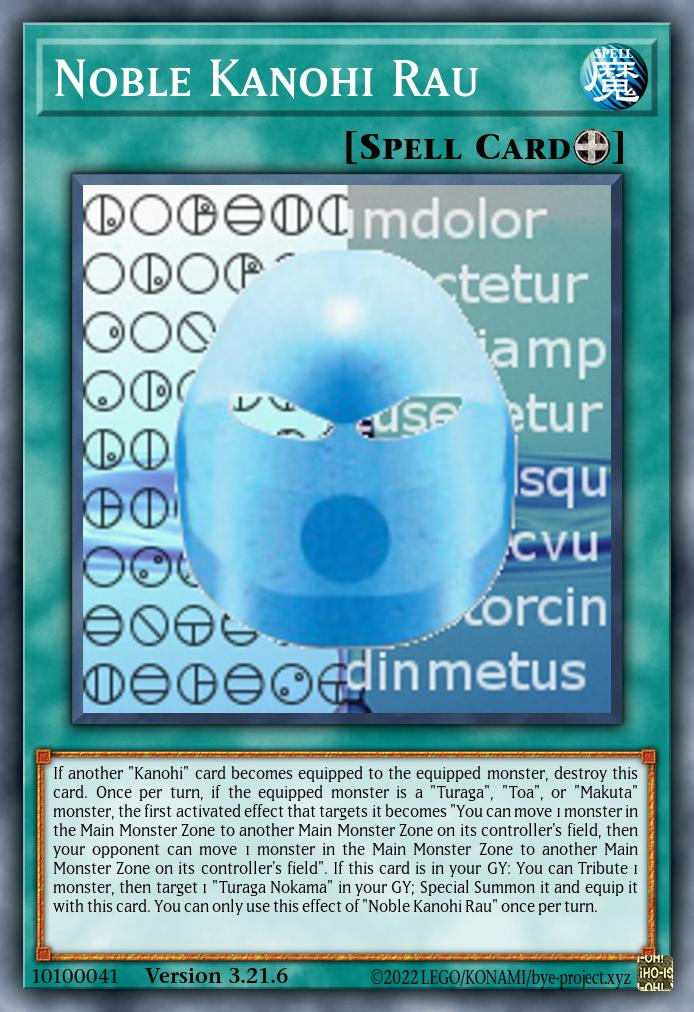
Noble Kanohi Rau

Equip Spell

If another “Kanohi” card becomes equipped to the equipped monster, destroy this card. Once per turn, if the equipped monster is a “Turaga”, “Toa”, or “Makuta” monster, the first activated effect that targets it becomes “You can move 1 monster in the Main Monster Zone to another Main Monster Zone on its controller’s field, then your opponent can move 1 monster in the Main Monster Zone to another Main Monster Zone on its controller’s field”. If this card is in your GY: You can Tribute 1 monster, then target 1 “Turaga Nokama” in your GY; Special Summon it and equip it with this card. You can only use this effect of “Noble Kanohi Rau” once per turn.

Bionicle: Coming of the Toa (v3.21.6)

In accordance with the particular type of “protection” offered by Ga-Koro, this WATER monster comes with a Quick Effect that you will often want to use on your opponent’s turn: The ability to make Nokama and everything she points to immune to 2 of the 3 card types in the game for the rest of the turn. A funny thing to note is that this immunity, instead of the usual “except its own” clause, makes an exception only for Nokama’s own effects, so you can do stuff like making an opponent’s monster unaffected by its own protection or stat boosts. This way, you can potentially get some benefit out of the arrow pointing to the opponent’s field. Finally, for synergy with both Ga-Koro’s purity concept and the general inclination of WATER monsters towards being discarded for cost, this effect comes at the price of banishing a card from the GY and discarding one. The banished card determines which card type is not included in the granted protection (to keep things a bit more fair and to leave yourself with ways to deal with an opponent’s monster in the relevant zone), while the discard allows triggering effects like Atlantean Heavy Infantry at any time.

Nokama’s other effects further play into this theme of protecting monsters she points to, with herself being indestructible in battle as long as one of those zones is filled (because being unaffected by stuff doesn’t help much if you’re a 1200 ATK monster that can easily be run over) and replenishing the fodder you need for the main effect as a reward if you manage to keep the monster(s) she’s pointing to alive until your opponent’s End Phase. Note that the latter is a quick effect rather than a trigger effect like it would usually be, so you can potentially chain it to something and take advantage of Ga-Koro.

The Kanohi Rau, Mask of Translation, adds a further level of complication by “translating” one targeting effect per turn into a “translation” along the Main Monster Zones. Not only does this functionally negate whatever the original effect meant to accomplish, but it also provides an opportunity to set up a monster placement that is convenient for Nokama.

What’s this? You want more Quick Effects? Well, you’ve come to the right place, because this floating village is populated by more than just its elder.

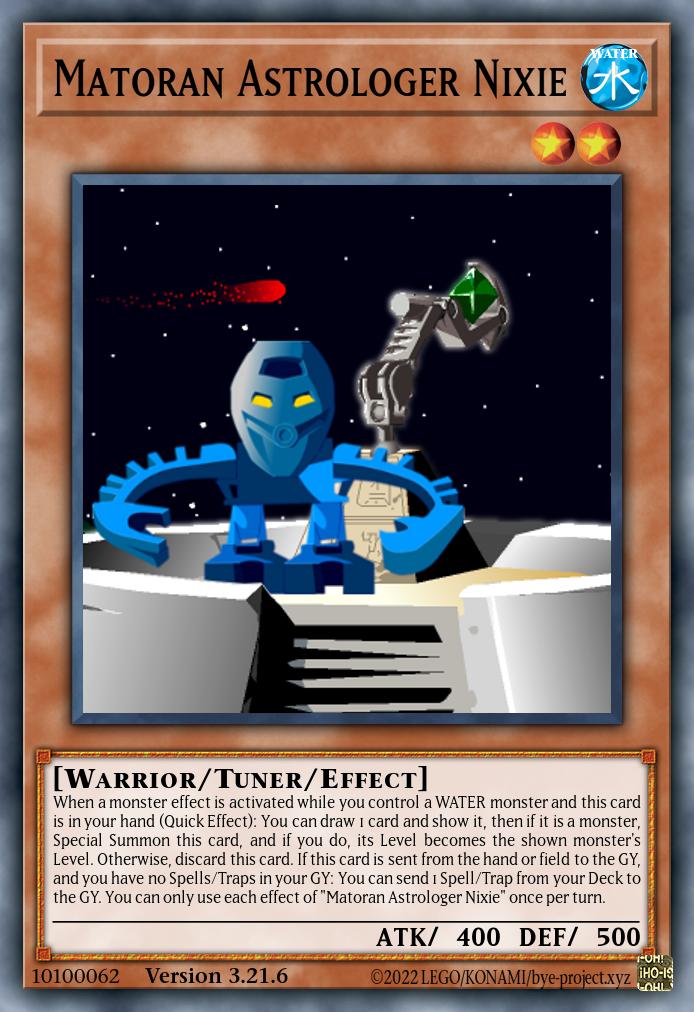
Matoran Astrologer Nixie

Tuner Effect MonsterLevel 2 | WATER Warrior | ATK 400 / DEF 500

When a monster effect is activated while you control a WATER monster and this card is in your hand (Quick Effect): You can draw 1 card and show it, then if it is a monster, Special Summon this card, and if you do, its Level becomes the shown monster’s Level. Otherwise, discard this card. If this card is sent from the hand or field to the GY, and you have no Spells/Traps in your GY: You can send 1 Spell/Trap from your Deck to the GY. You can only use each effect of “Matoran Astrologer Nixie” once per turn.

Bionicle: Coming of the Toa (v3.21.6)

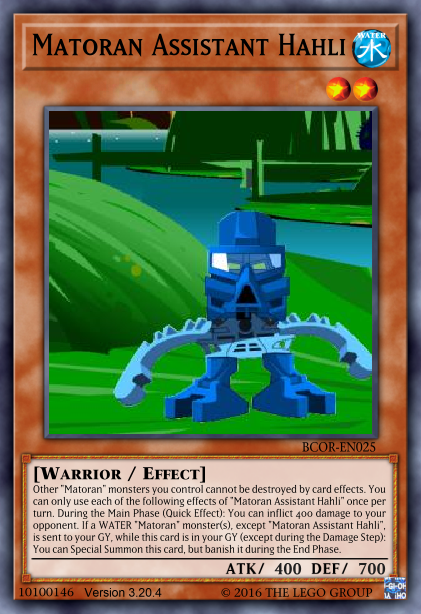
Matoran Assistant Hahli

Effect MonsterLevel 2 | WATER Warrior | ATK 400 / DEF 700

Other “Matoran” monsters you control cannot be destroyed by card effects. You can only use each of the following effects of “Matoran Assistant Hahli” once per turn. During the Main Phase (Quick Effect): You can inflict 400 damage to your opponent. If a WATER “Matoran” monster(s), except “Matoran Assistant Hahli”, is sent to your GY, while this card is in your GY (except during the Damage Step): You can Special Summon this card, but banish it during the End Phase.

Bionicle: Challenge of the Rahi (v3.20.4)

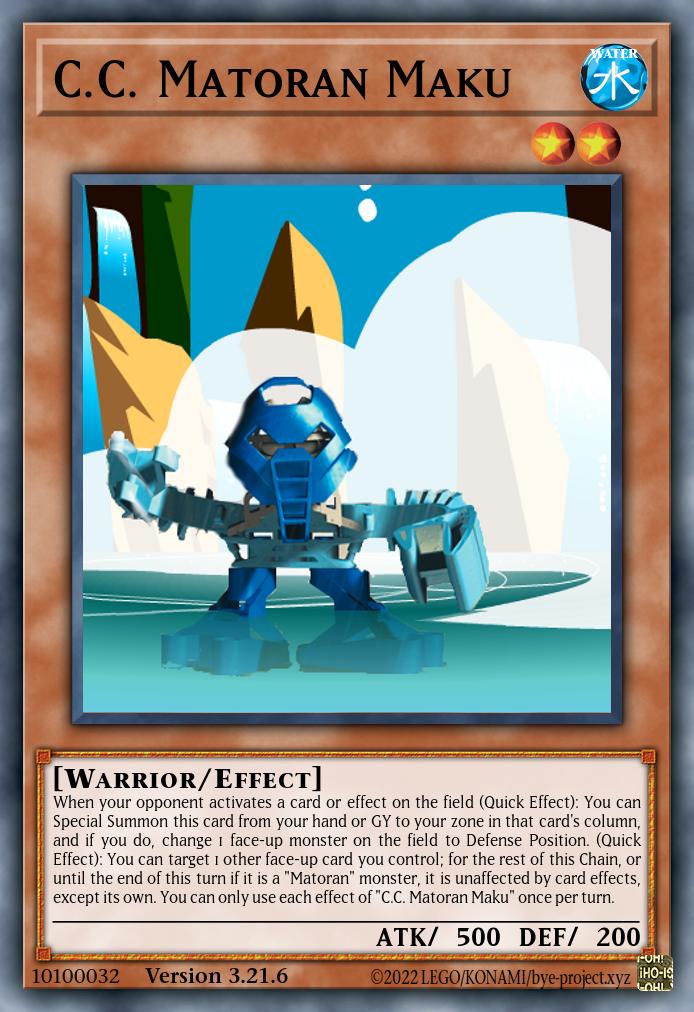
C.C. Matoran Maku

Effect MonsterLevel 2 | WATER Warrior | ATK 500 / DEF 200

When your opponent activates a card or effect on the field (Quick Effect): You can Special Summon this card from your hand or GY to your zone in that card’s column, and if you do, change 1 face-up monster on the field to Defense Position. (Quick Effect): You can target 1 other face-up card you control; for the rest of this Chain, or until the end of this turn if it is a “Matoran” monster, it is unaffected by card effects, except its own. You can only use each effect of “C.C. Matoran Maku” once per turn.

Bionicle: Coming of the Toa (v3.21.6)

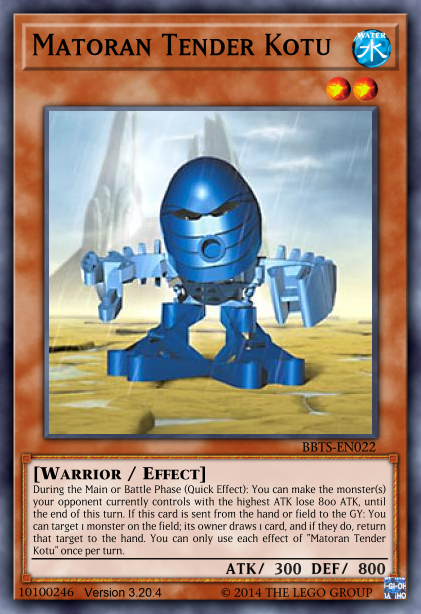
Matoran Tender Kotu

Effect MonsterLevel 2 | WATER Warrior | ATK 300 / DEF 800

During the Main or Battle Phase (Quick Effect): You can make the monster(s) your opponent currently controls with the highest ATK lose 800 ATK, until the end of this turn. If this card is sent from the hand or field to the GY: You can target 1 monster on the field; its owner draws 1 card, and if they do, return that target to the hand. You can only use each effect of “Matoran Tender Kotu” once per turn.

Bionicle: Beware the Swarm (v3.20.4)

There’s the astrologer Nixie, who can draw you a card and (with some luck) Special Summon herself from the hand in response to any monster effect activated while you control a WATER monster. If you do draw a monster from this effect and thus get Nixie on the field, the included Level modulation combined with her Tuner status could also be helpful in making a big Synchro Monster to pair up with Nokama. If you’re not as lucky with your draw and end up having to discard Nixie, she can potentially still help set up Nokama for granting protection from monsters by putting a Spell/Trap in the GY to banish – but only if you didn’t already have one. This will also trigger when used as material for Nokama or a Synchro or even when discarded for Nokama’s cost, so that particular piece of setup is quite accessible.

Hahli, at this point in time a mere assistant flax maker, does nothing flashy by herself, but provides valuable assistance to her fellow Matoran in various ways. There’s obviously the destruction protection, but the small Quick Effect burn is also not to be underestimated – not because of the damage it deals, but because it gives you +1 chain length and thus a chance to activate more impactful Quick Effects in the range where Ga-Koro shields them from interference, not to mention giving Nixie an opportunity to activate from the hand. The GY effect serves a similar purpose, as it will trigger together with another Ga-Matoran’s floating effect and thus let you either chain block or build the chain the way you want it for Ga-Koro.

Maku even gives us not one, but two quick effects. On the field, you can make a card unaffected by other effects for a single Chain only, which is obviously something that only makes sense as Chain Link 2 or higher and therefore works perfectly for Ga-Koro’s protection. As a little special clause, fellow Matoran get to remain unaffected for an entire turn – imagine it as them being taught to swim, as opposed to just being briefly held above the water like everything else. In the hand or GY, she summons herself when your opponent activates an effect in a free column, which is also inherently at Chain Link 2 or higher.

Finally, Kotu’s Quick Effect lets her calm your opponent’s most ferocious beast with an ATK reduction, a reference to her job of tending to even large Rahi like Tarakava after they leave Makuta’s control. She also comes with a disruptive floating effect (once again, set up so it triggers when discarded for Nokama’s cost) that works best when used on something of yours controlled by your opponent, but may otherwise still be worth it if you can hit a choke point.

And with that, all that’s left is the resident heroine and Main Deck boss, Gali.

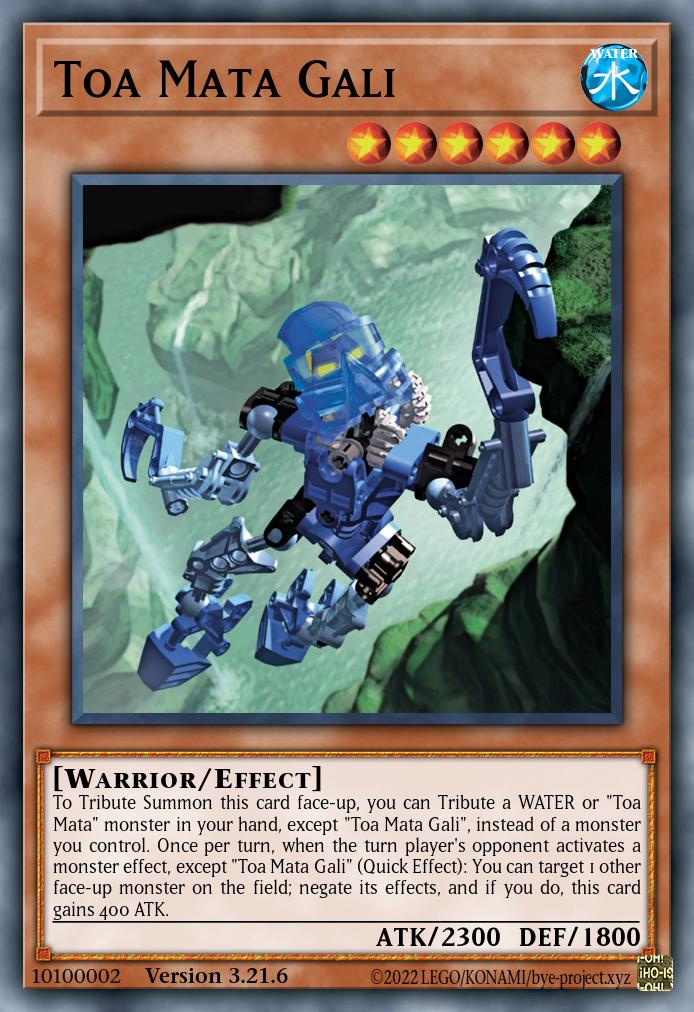
Toa Mata Gali

Effect MonsterLevel 6 | WATER Warrior | ATK 2300 / DEF 1800

To Tribute Summon this card face-up, you can Tribute a WATER or “Toa Mata” monster in your hand, except “Toa Mata Gali”, instead of a monster you control. Once per turn, when the turn player’s opponent activates a monster effect, except “Toa Mata Gali” (Quick Effect): You can target 1 other face-up monster on the field; negate its effects, and if you do, this card gains 400 ATK.

Bionicle: Coming of the Toa (v3.21.6)

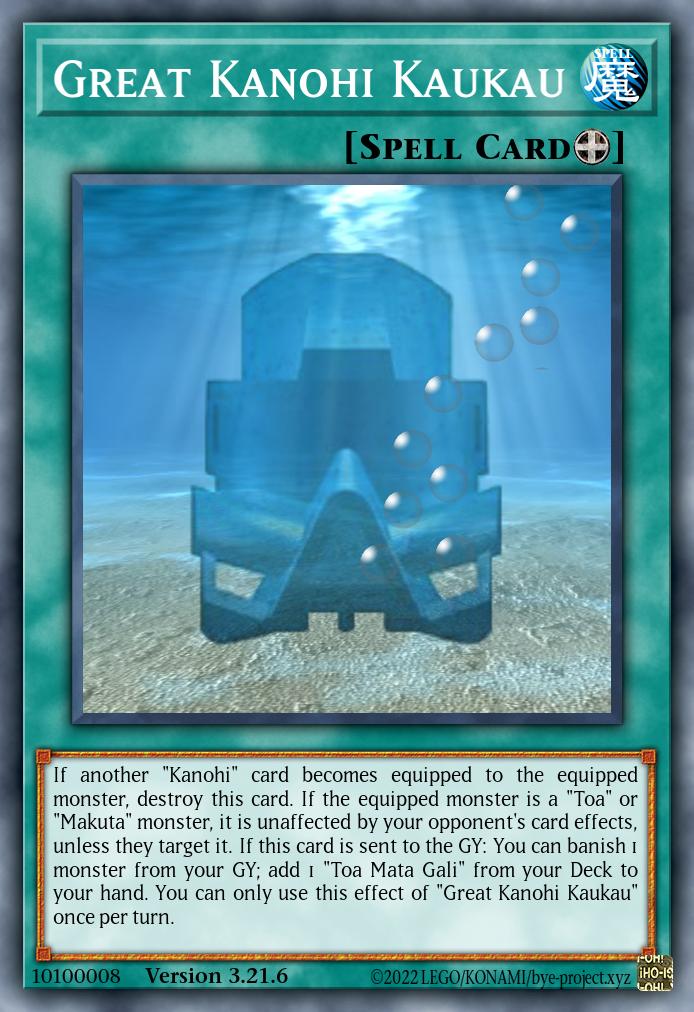
Great Kanohi Kaukau

Equip Spell

If another “Kanohi” card becomes equipped to the equipped monster, destroy this card. If the equipped monster is a “Toa” or “Makuta” monster, it is unaffected by your opponent’s card effects, unless they target it. If this card is sent to the GY: You can banish 1 monster from your GY; add 1 “Toa Mata Gali” from your Deck to your hand. You can only use this effect of “Great Kanohi Kaukau” once per turn.

Bionicle: Coming of the Toa (v3.21.6)

Now, what does the Toa of Water bring to the aid of her village? You guessed it, another Quick Effect. This one can be chained to any monster effects activated by the turn player’s opponent (for Ga-Koro’s purposes, this particularly means your effects during the opponent’s turn), negates a face-up monster, and gives Gali an ATK boost that can potentially stack to infinity with enough patience. So we basically have three main uses:

  • Bonus disruption during the opponent’s turn whenever you already have a monster effect that can activate (e.g. a Ga-Matoran)
  • Shutting down your opponent’s monster-based disruption on the field during your turn
  • Stacking ATK boosts to get over big monsters in battle (something Ga-Koro otherwise struggles with)

Meanwhile, the Kanohi Kaukau, Mask of Water Breathing, offers an additional layer of protection from non-targeting effects, leaving you free to save your Nokama for something else. Though really it’s just a joke about Torrential Tribute if I’m quite honest.

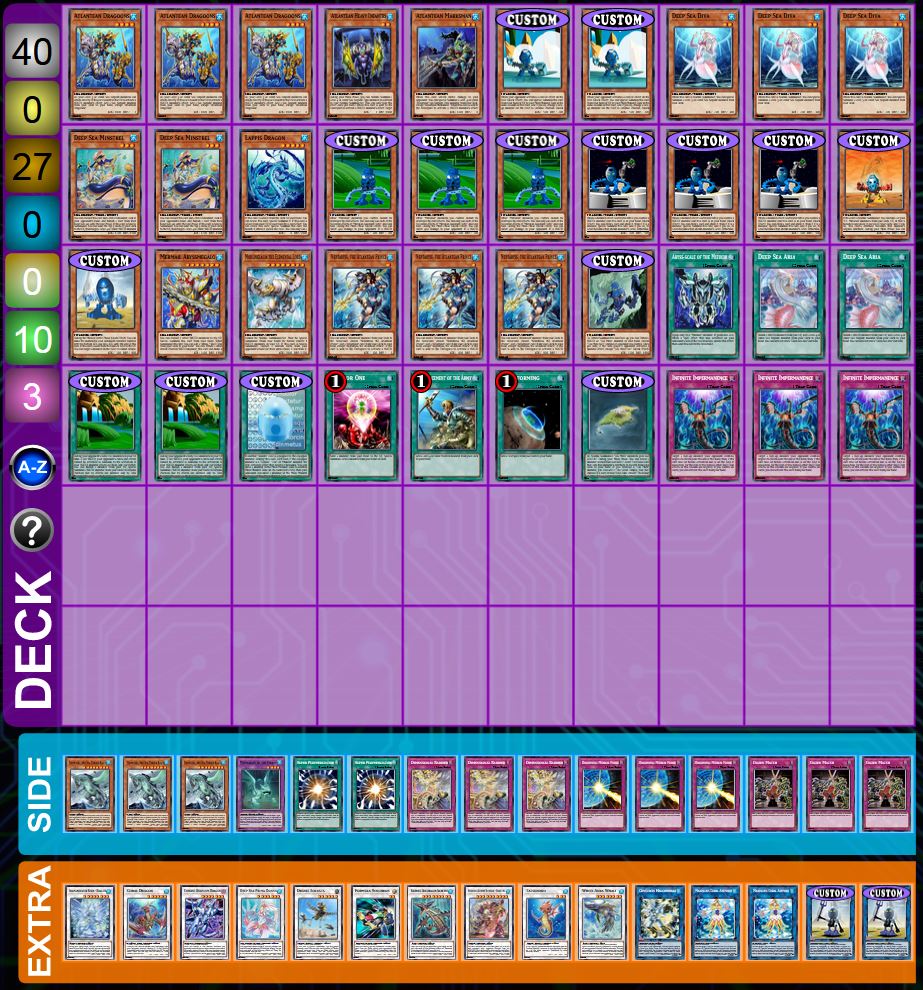
Sample Deck

https://www.duelingbook.com/deck?id=10264388

Being a WATER-based strategy that discards for cost as one of its key plays, it seemed natural to use Atlanteans, and Mermails along with them. Using (restricted versions of) standard issue combos I will not cover in detail here, you can put out big monsters like Abyssmegalo + Mizuchi, Moulinglacia, or any of the high-Level Synchros in your Extra Deck to serve as the target of Nokama’s protection. Possibly the best you can get is Chengying, because Nokama banishing for cost lets you trigger his effect whenever you damn feel like it and just get rid of two of your opponent’s cards.

To make Nokama herself, we just need to find one of our many Ga-Matoran at any point throughout the combo, which is made easy by Nixie being a Level 2 Tuner, well within the range of what good ol’ Halqifibrax can fetch. Even his effect during the opponent’s turn would be pretty good to put a fresh monster into Nokama’s zone when needed, if not for the fact that the two of them tend to compete for the Extra Monster Zone and thus rarely coexist on the field. Finally, Marincess Coral Anemone comes up a fair bit because she not only extends your combos, but also brings back Nokama in just the right spot to make her live, though not necessarily in the strongest possible configuration.

Best of Test

Best of Test: Ga-Koro (v3.12.10)

Conclusion

Decks centered around Ga-Koro focus mainly on quick effects chained to the opponent’s own plays on their turn. By utilizing Nokama’s solid protection in tandem with disruptive effects like Gali, Maku, Kotu, and even Atlanteans, you can establish a successful control strategy to keep your cards on the board while interfering with the opponent enough to keep victory within reach.

Theme Guide: Ta-Koro (BCOT)

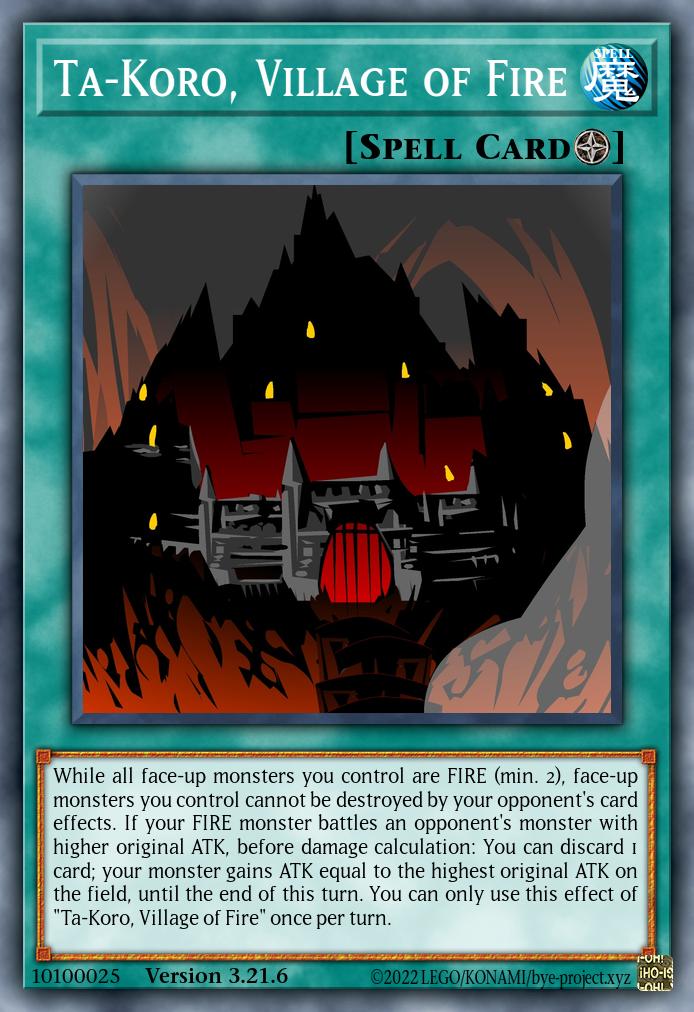
Amidst the lava flowing from the Mangai volcano lies the fortified village of Ta-Koro, home to the steadfast Ta-Matoran who live according to the Principle of Courage.

Ta-Koro, Village of Fire

Field Spell

While all face-up monsters you control are FIRE (min. 2), face-up monsters you control cannot be destroyed by your opponent’s card effects. If your FIRE monster battles an opponent’s monster with higher original ATK, before damage calculation: You can discard 1 card; your monster gains ATK equal to the highest original ATK on the field, until the end of this turn. You can only use this effect of “Ta-Koro, Village of Fire” once per turn.

Bionicle: Coming of the Toa (v3.21.6)

This principle also guides the design of the Field Spell representing the village, as well as the strategy surrounding it. First you have a protection effect on the condition that you control multiple FIRE monsters (and no others) – a reference to both the solid walls surrounding Ta-Koro and the idea that protecting one’s allies is a notable way to show courage. But most defining for the playstyle is the second effect, which allows your FIRE monsters to always win in battle if they are courageously facing a monster with higher ATK. Higher original ATK, that is.

That last part, as you might imagine, is the one you’re meant to “abuse” in order to win the game. Essentially, a Ta-Koro deck is focused around boosting the ATK of your own monsters and/or reducing that of the opponent’s monsters before you charge into battle and inflict massive damage. Ideally you want 8000 or more, but if you don’t get there, the walls of Ta-Koro might just let you survive a turn so you can finish the job.

The first precondition to making all this work is of course getting Attack Position monsters to both sides of the field, as your damage potential will be considerably limited if you are only attacking directly. Luckily, this basic setup can be guaranteed by the village’s leader, Turaga Vakama.

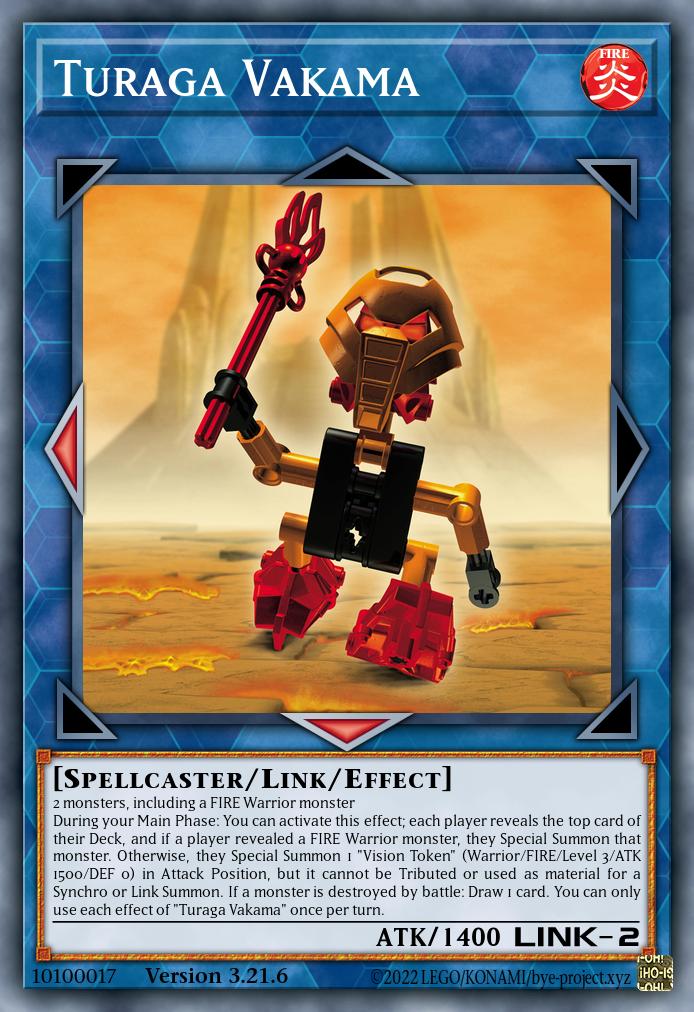
Turaga Vakama

Link Effect MonsterLink-2 [◀ ▼] | FIRE Spellcaster | ATK 1400

2 monsters, including a FIRE Warrior monster
During your Main Phase: You can activate this effect; each player reveals the top card of their Deck, and if a player revealed a FIRE Warrior monster, they Special Summon that monster. Otherwise, they Special Summon 1 “Vision Token” (Warrior/FIRE/Level 3/ATK 1500/DEF 0) in Attack Position, but it cannot be Tributed or used as material for a Synchro or Link Summon. If a monster is destroyed by battle: Draw 1 card. You can only use each effect of “Turaga Vakama” once per turn.

Bionicle: Coming of the Toa (v3.21.6)

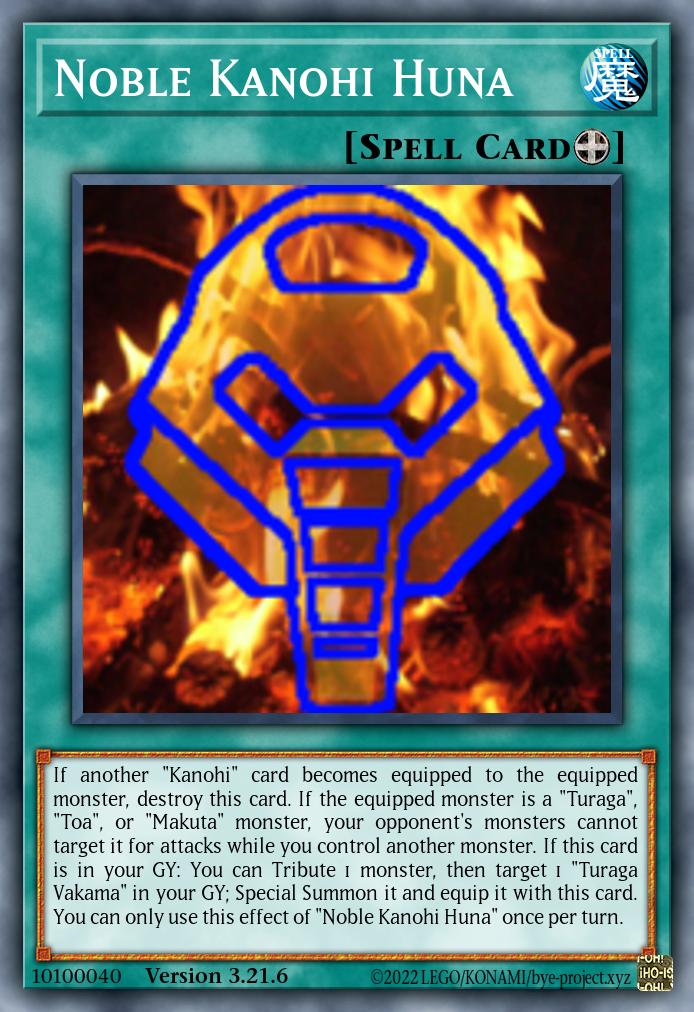
Noble Kanohi Huna

Equip Spell

If another “Kanohi” card becomes equipped to the equipped monster, destroy this card. If the equipped monster is a “Turaga”, “Toa”, or “Makuta” monster, your opponent’s monsters cannot target it for attacks while you control another monster. If this card is in your GY: You can Tribute 1 monster, then target 1 “Turaga Vakama” in your GY; Special Summon it and equip it with this card. You can only use this effect of “Noble Kanohi Huna” once per turn.

Bionicle: Coming of the Toa (v3.21.6)

Known to experience visions of the future, Vakama comes with an activated effect to peek at the future that is the top card of each player’s Deck, and depending on what is found there, will cause that player to Special Summon a monster to your field. If a FIRE Warrior, which is of course the Attribute and Type of Ta-Koro’s inhabitants, is found, it will come to the field with no strings attached, able to attack, use its effects, or be material to your heart’s content. Anything else will instead be replaced by an Attack Position Token that is pretty much stuck on the field until someone destroys it. Bottom line is that no matter how this effect resolves, it will end with an additional monster on each side of the field, which is exactly what this strategy wants. Even better is the fact that your opponent’s will, in all likelihood, be the Attack Position Token with an ATK stat that is just a little bigger than Vakama’s own and thus enables the boost from Ta-Koro.

The secondary effect simply rewards you for sticking to the battle-focused gameplan with a free draw, which is of course convenient to offset the discard cost of Ta-Koro. It also combos with Vakama’s Mask of Concealment, the Kanohi Huna, which forces the opponent to get over your other monsters first if they want to attack him, thus giving you the opportunity to get another draw before he’s destroyed. And on your next turn, as is generally the case with the Turaga’s Noble Kanohi, you can just Tribute something (though sadly not a Vision Token) to bring the Huna and its wearer right back to the field.

We’ve covered how to get the monsters needed for battle, but to get some really good damage going and deal with potential impediments to our rather simplistic win condition, it’s going to need some more help. This is where the Ta-Matoran come in, making up both the majority of the village’s population and of our Main Deck monster lineup.

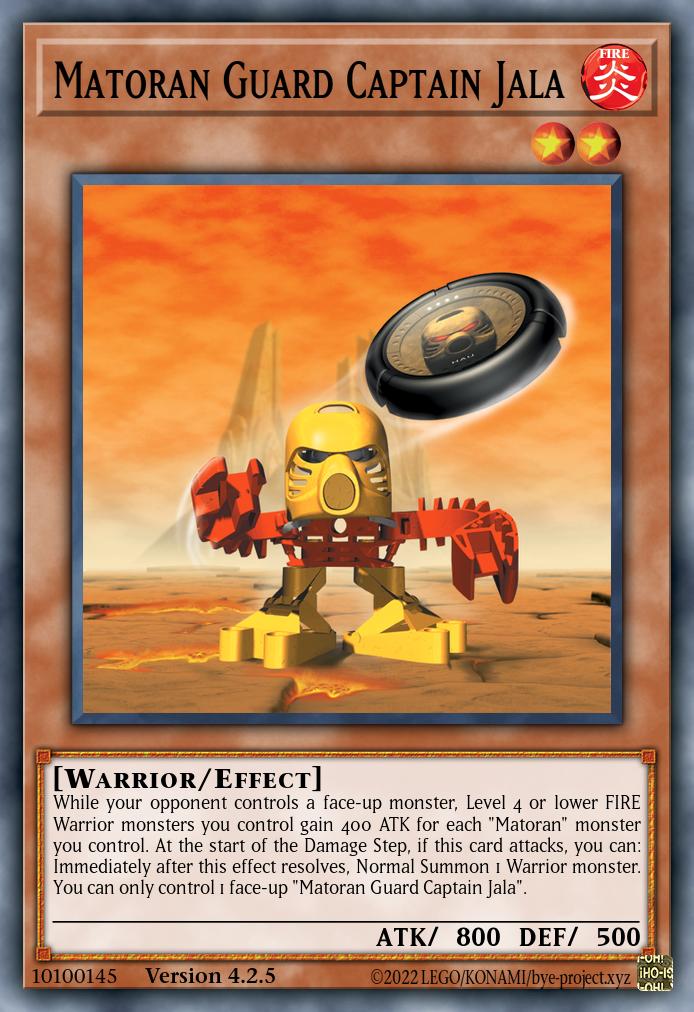
Matoran Guard Captain Jala

Effect MonsterLevel 2 | FIRE Warrior | ATK 800 / DEF 500

While your opponent controls a face-up monster, Level 4 or lower FIRE Warrior monsters you control gain 400 ATK for each “Matoran” monster you control. At the start of the Damage Step, if this card attacks, you can: Immediately after this effect resolves, Normal Summon 1 Warrior monster. You can only control 1 face-up “Matoran Guard Captain Jala”.

Bionicle: Challenge of the Rahi (v4.2.5)

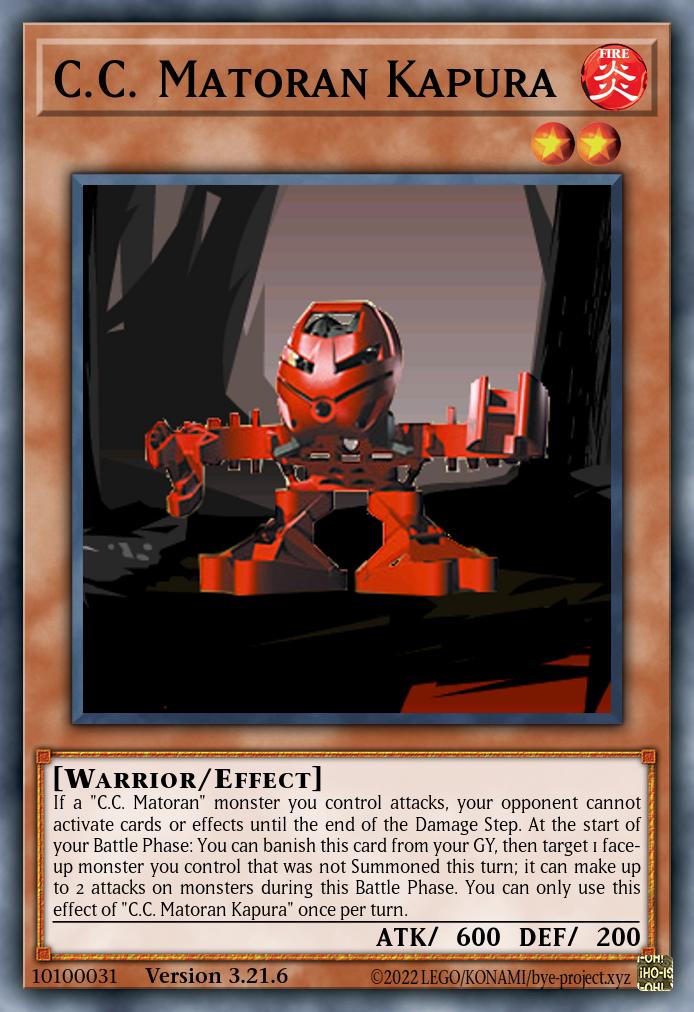
C.C. Matoran Kapura

Effect MonsterLevel 2 | FIRE Warrior | ATK 600 / DEF 200

If a “C.C. Matoran” monster you control attacks, your opponent cannot activate cards or effects until the end of the Damage Step. At the start of your Battle Phase: You can banish this card from your GY, then target 1 face-up monster you control that was not Summoned this turn; it can make up to 2 attacks on monsters during this Battle Phase. You can only use this effect of “C.C. Matoran Kapura” once per turn.

Bionicle: Coming of the Toa (v3.21.6)

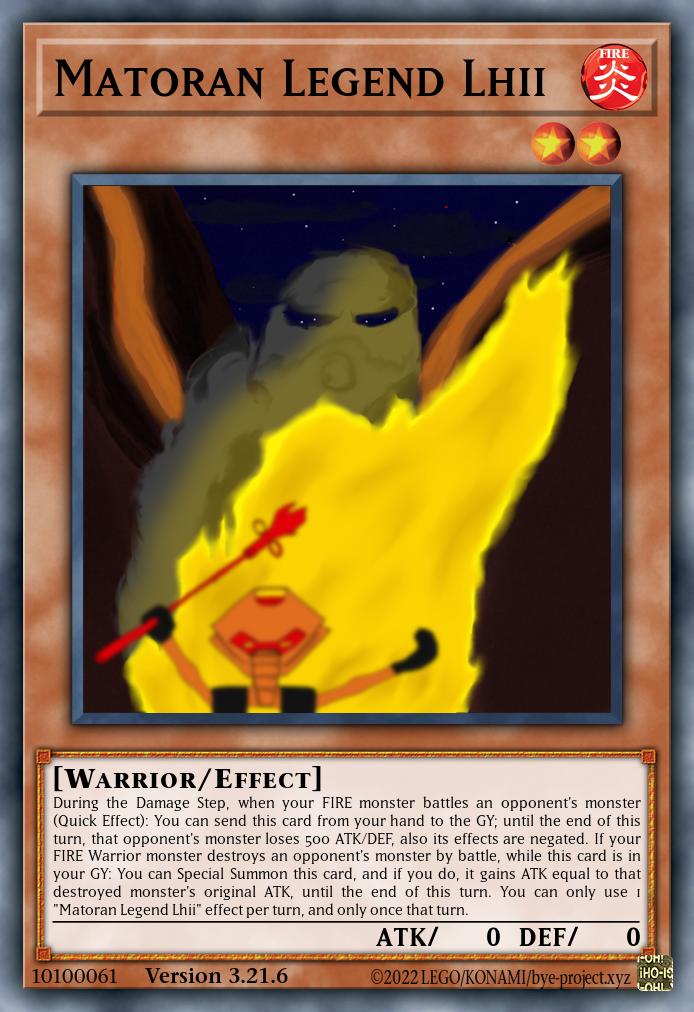
Matoran Legend Lhii

Effect MonsterLevel 2 | FIRE Warrior | ATK 0 / DEF 0

During the Damage Step, when your FIRE monster battles an opponent’s monster (Quick Effect): You can send this card from your hand to the GY; until the end of this turn, that opponent’s monster loses 500 ATK/DEF, also its effects are negated. If your FIRE Warrior monster destroys an opponent’s monster by battle, while this card is in your GY: You can Special Summon this card, and if you do, it gains ATK equal to that destroyed monster’s original ATK, until the end of this turn. You can only use 1 “Matoran Legend Lhii” effect per turn, and only once that turn.

Bionicle: Coming of the Toa (v3.21.6)

Jala, as the captain of the Ta-Koro Guard, leads your Matoran (and other low-level FIRE Warriors, including Vakama’s Vision Token!) into battle and boosts their ATK as long as there is actually an enemy force to take on. He also helps you gather your fighters on the field in the first place by allowing an extra Normal Summon of a Warrior when he attacks, which means you can up the stat boost a little more by getting an extra Matoran, among other things.

Kapura is a mysterious character mostly known for his skill in traveling quickly by moving slowly, and as a member of The Chronicler’s Company. His first effect is direct support for that group, but also applies to himself in a Ta-Koro deck, making it so your opponent literally gets Kapura’d and cannot react in time to respond whenever he attacks – and with backup such as your Field Spell, this is extremely dangerous despite the low ATK stat. The second effect implements his signature combination of slow and fast, speeding up your damage output with a double attack on the rather slow condition that a monster has to survive a whole turn first. Makes for a good backup plan in case you can’t immediately OTK or are forced to go first.

Lhii the Surfer is a legendary Ta-Matoran who never truly existed and was merely made up by Vakama in memory of Toa Lhikan, which is why his stats are both 0 and he doesn’t actually do anything on the field. However, he makes significant contributions in the Battle Phase by either weakening an opponent’s monster from the hand – allowing you to clear pesky obstacles such as battle protection – or joining the battle himself by rising from the GY with the ATK of an opponent’s monster you just destroyed (but still an original ATK of 0, conveniently). Granted, I’m not sure how that last one makes sense given the fact that he isn’t real, but it certainly is useful to take out that last bit of LP. And of course, you can’t do both in one turn because the discard cost of the hand effect would mean the GY effect could immediately trigger from the same battle, which would be silly.

And if an enemy is too great to defeat even with all the tools the deck has access to in battle? If there are perhaps multiple humongous monsters blocking your way and the single Ta-Koro boost is not enough to get rid of them all? Well in that case, we need a hero.

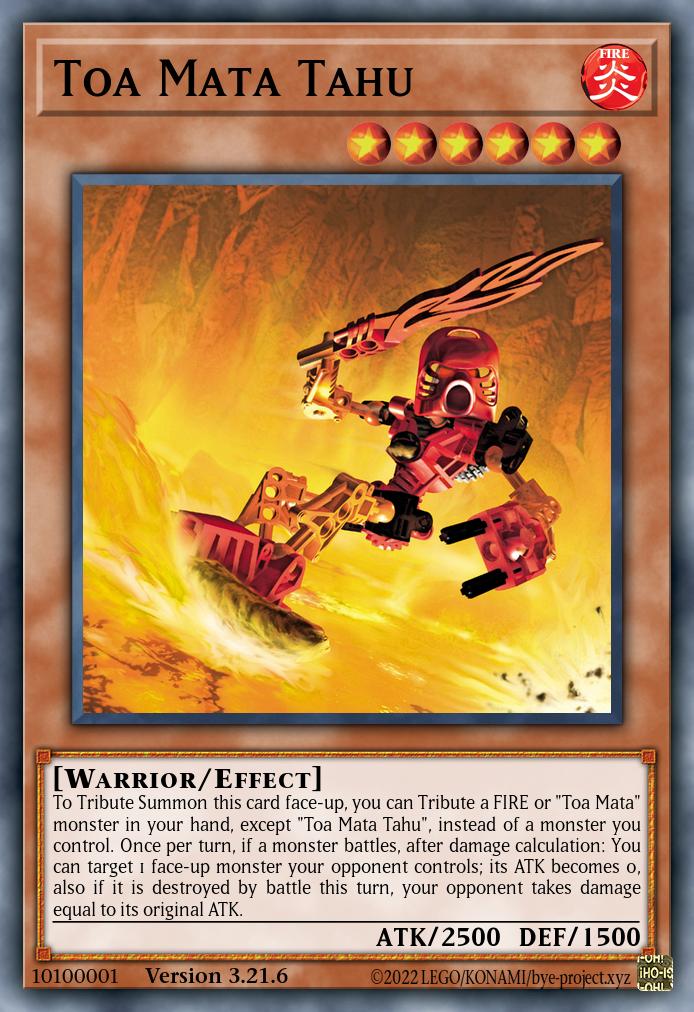
Toa Mata Tahu

Effect MonsterLevel 6 | FIRE Warrior | ATK 2500 / DEF 1500

To Tribute Summon this card face-up, you can Tribute a FIRE or “Toa Mata” monster in your hand, except “Toa Mata Tahu”, instead of a monster you control. Once per turn, if a monster battles, after damage calculation: You can target 1 face-up monster your opponent controls; its ATK becomes 0, also if it is destroyed by battle this turn, your opponent takes damage equal to its original ATK.

Bionicle: Coming of the Toa (v3.21.6)

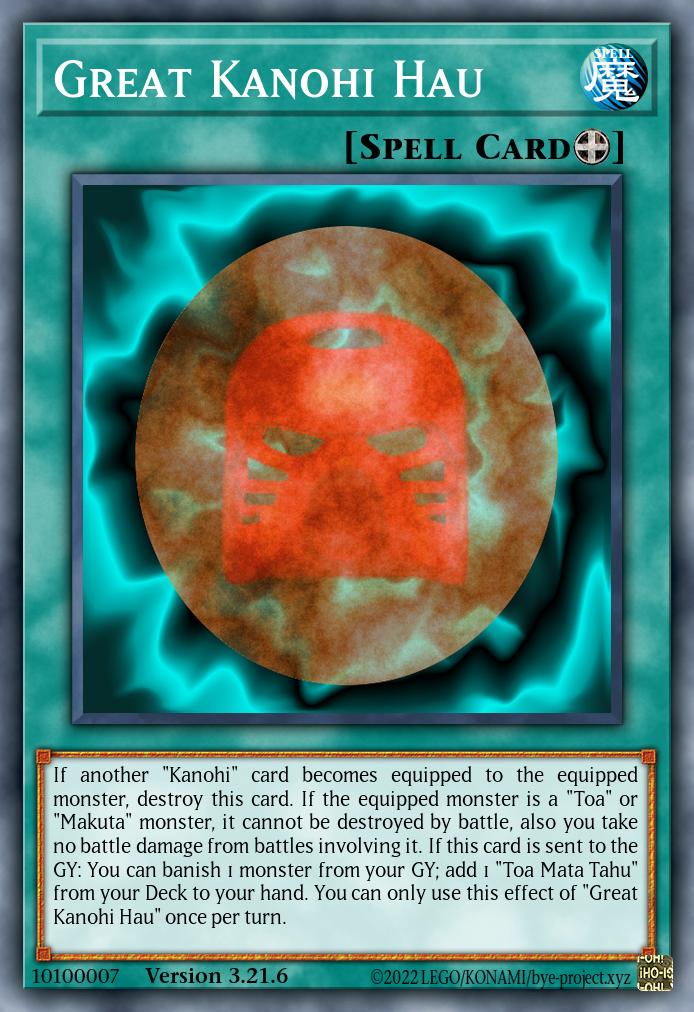
Great Kanohi Hau

Equip Spell

If another “Kanohi” card becomes equipped to the equipped monster, destroy this card. If the equipped monster is a “Toa” or “Makuta” monster, it cannot be destroyed by battle, also you take no battle damage from battles involving it. If this card is sent to the GY: You can banish 1 monster from your GY; add 1 “Toa Mata Tahu” from your Deck to your hand. You can only use this effect of “Great Kanohi Hau” once per turn.

Bionicle: Coming of the Toa (v3.21.6)

Tahu is possibly the greatest OTK enabler Ta-Koro has when faced with a large number of monsters. After a battle has occurred (no matter who battled, or who won), he can reduce the ATK of a monster that remains on the field to 0 and make it so that monster’s destruction in battle will burn your opponent for its original ATK this turn. Or in other words, he sets monsters on fire so they can’t fight properly and die in a big explosion when you hit them. And the Kanohi Hau, Mask of Shielding, offers simple battle protection that lets you trigger Tahu’s effect with zero risk.

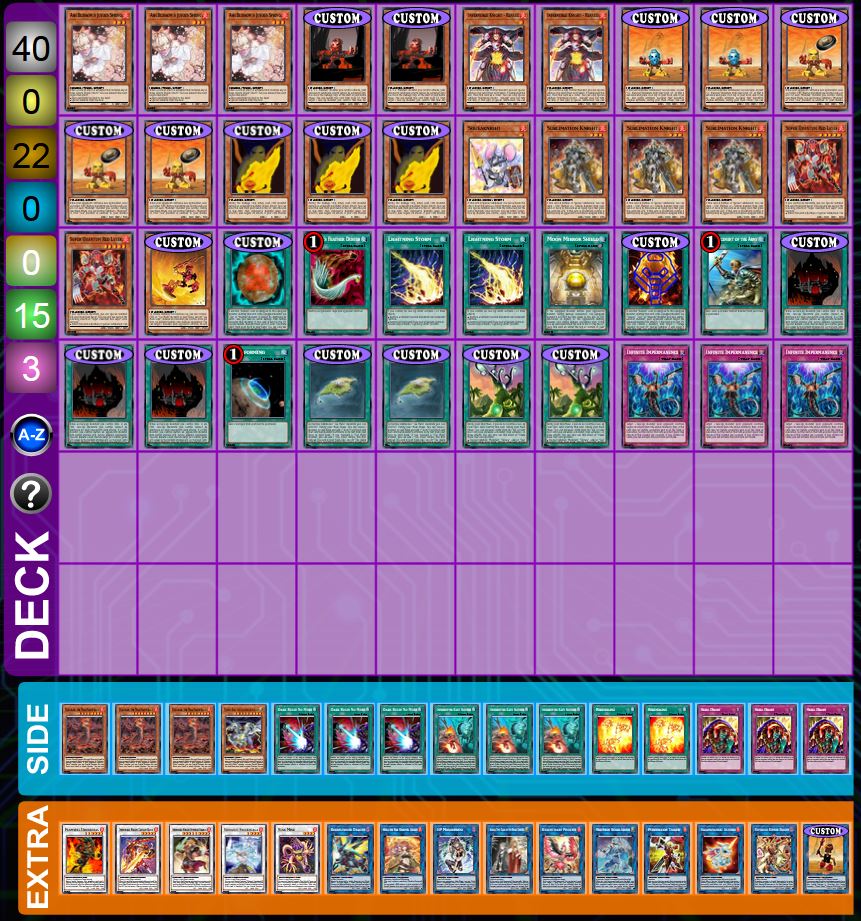
Sample Deck

https://www.duelingbook.com/deck?id=10262211

Since the Battle Phase is our main win condition and there’s not that much you can do to set up a first-turn board while sticking to FIRE monsters, the deck is generally built to go second. That means we use both handtraps such as Ash Blossom (conveniently matches the Attribute!) and Infinite Impermanence to hopefully stop the opponent from setting up anything we can’t deal with, and cards like Lightning Storm, Harpie’s Feather Duster, and the Kaiju package in the Side Deck to expand the range of what we can deal with. There’s also an argument to be made that you could focus on going first with more diverse Attributes in the Extra Deck (since you aren’t locked or anything) and take advantage of Ta-Koro’s protection and Kapura-granted double attacks, but I haven’t tried that yet, so …

The line you basically want to go for, after using the going second staples to bring your opponent’s field as close as possible to the ideal of “multiple Attack Position monsters that don’t do anything”, is pretty simple: Put as many FIRE Warriors on the field as you can (with some combination of Jala’s extra Normal Summon, Takua getting Kapura from the Deck, and the free Special Summons offered by Red Layer/Sublimation Knight/Renaud), make Isolde and/or Vakama in order to get even more FIRE Warriors on the field, go into whatever Links and Synchros maximize your damage output in the present gamestate, and ideally activate Ta-Koro, bring out Tahu, and get Lhii into your GY. If you manage to do all of these, it’s usually an OTK, if you just do some it’s still a good bit of damage. I:P Masquerena and Avramax are a good combination to have available in case you do find yourself with the need to survive another turn.

Best of Test

Best of Test: Ta-Koro (v3.12.10)

Conclusion

Ta-Koro is a straightforward beatdown deck with OTK potential, whose special thematic feature is that you generally want to courageously hit over monsters (the bigger the better) in order to benefit from the Field Spell’s ATK boost and trigger other effects that significantly increase your damage output. This is helped by Vakama putting a Token on your opponent’s field while also increasing the number of attackers you have available, and if you can’t finish the job in one turn, there’s still at least built-in destruction protection for your FIRE monsters.