
That’s right, six servings of X-Koro with nothin’.

Or rather, only stuff from this expansion. [CSTM] tags all over, not a single card bearing the unforged signature of John Konami in sight. Spoiler: For the most part that means we’re putting various kinds of Rahi in them, since those break down surprisingly well into different Attributes, and there are explicit points of interaction by design in some cases.
The inspiration for doing this draws from multiple sources: First, the BCOT overhaul these six strategies originate from were a time where I really started leaning into giving my cards small synergies with stuff from the base game, as well as deckbuilding and testing that way. As a consequence, the decks featuring the villages and Matoran of Mata Nui were designed as hybrids from the ground up, and I never really investigated how functional they are in a vacuum. Second, the next update in the pipeline is quite literally “The -Koro Update”, which means it would be prudent to develop a solid idea of what specifically is in the most dire need of updating here. And third, over the course of the semi-recent odyssey in which I made a Dungeon Duel Monsters campaign, it was brought to my attention that some people actually do very much prefer not having any regular Yugioh cards mixed in with their customs. In fact, that’s how DDM constructed formats work, so this post now provides some actual decks to use in the Bionicle one – I made sure to stick to the v4.8.6 cutoff, so no BMOL cards in these.
You can check them out some gameplay here:

And read on below for the exact considerations and different ingredients involved.
Recurring Engines
While building, I quickly noticed there were some cards that just helped a great deal in making decks run smoothly: the newer ones from the BPEV and Rahi Update era, where I had settled on a pretty good formula for making consistent engines with a clear payoff. This led to certain packages appearing multiple times, so to save time in profiles I’ll explain them here in advance.
Toa Nuva

Tales of the Nuva
Continuous SpellWhen this card is activated: You can add 1 “Energized Protodermis” card from your Deck to your hand. If a “Nuva” Spell/Trap(s) is sent from the hand and/or Deck to your GY: You can target 1 of them; Set it to your field. If your opponent activates a monster effect: You can send this card to the GY, then target 1 “Toa Nuva” monster you control or in your GY; shuffle it into the Deck, and if you do, you can Special Summon 1 “Toa Nuva” Fusion Monster with a different name from your Extra Deck. You can only use each effect of “Tales of the Nuva” once per turn.
The epitome of this category, as I used it for six out of six villages. You see, in a deck that plays a Toa Mata (all of these do) and has some room in the Extra Deck (all of these do, given the lack of generic tools), playing some Energized Protodermis cards simply provides a chance to upgrade your board with a powerful boss monster that also brings its own second layer in the form of backrow with it. All you need to do is draw both your Toa Mata (slightly bricky on its own) and access to Energized Protodermis (total brick on its own) … which sounds kind of bad, but works out well enough for how janky these decks are in general.
What exactly this engine provides depends on which Toa we’re talking about, but the general design direction for the Mata (and by extension the Nuva) from the start was to have them slot into their respective village’s gameplan, so it generally works out to something useful. The backrow component is something we can vary separately from that, and I tried some different approaches in the different builds – using just the Nuva Symbol, running Nuva Emergence with a second copy of the Toa Nuva we can actually fuse, and/or trying to boost the ceiling with Nuva Overcharge as a negation Counter Trap. My feeling after testing is that Symbol+Emergence seem to be the most solid combination, since both actually help you get into the Nuva as well.
Finally, my single favorite term in this whole equation might just be Tales of the Nuva , which essentially makes it so that the one Toa Nuva we can make from our respective Toa Mata is, more or less, still every Toa Nuva. We d0 have Extra Deck space to spare, after all.
Chronicler’s Company
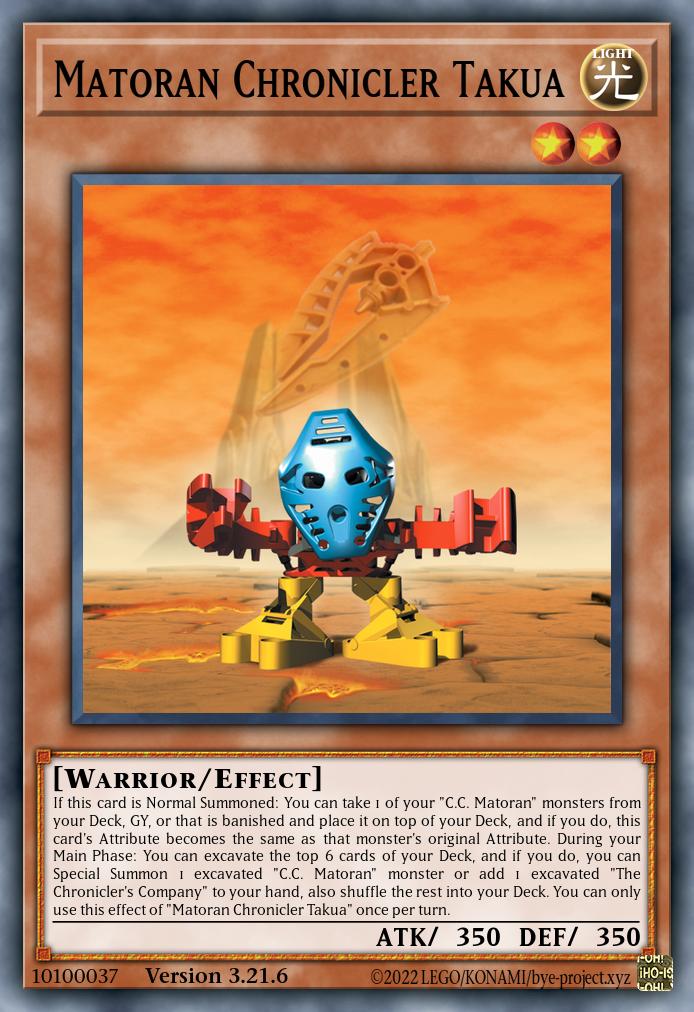
Matoran Chronicler Takua
Effect MonsterLevel 2 | LIGHT Warrior | ATK 350 / DEF 350If this card is Normal Summoned: You can take 1 of your “C.C. Matoran” monsters from your Deck, GY, or that is banished and place it on top of your Deck, and if you do, this card’s Attribute becomes the same as that monster’s original Attribute. During your Main Phase: You can excavate the top 6 cards of your Deck, and if you do, you can Special Summon 1 excavated “C.C. Matoran” monster or add 1 excavated “The Chronicler’s Company” to your hand, also shuffle the rest into your Deck. You can only use this effect of “Matoran Chronicler Takua” once per turn.
Not quite an outsider, but Takua still fits the bill as a guy you can just Normal Summon and make a Turaga by getting the respective village’s Chronicler’s Company member from your Deck. For this ability, he (and his local partner in crime) has been include in some, but not all of these strategies, based on considerations of how important getting to the Turaga is, how many starters we already have, and how well a LIGHT monster can be made to fit inside the applicable Attribute restrictions.
Beast Rahi
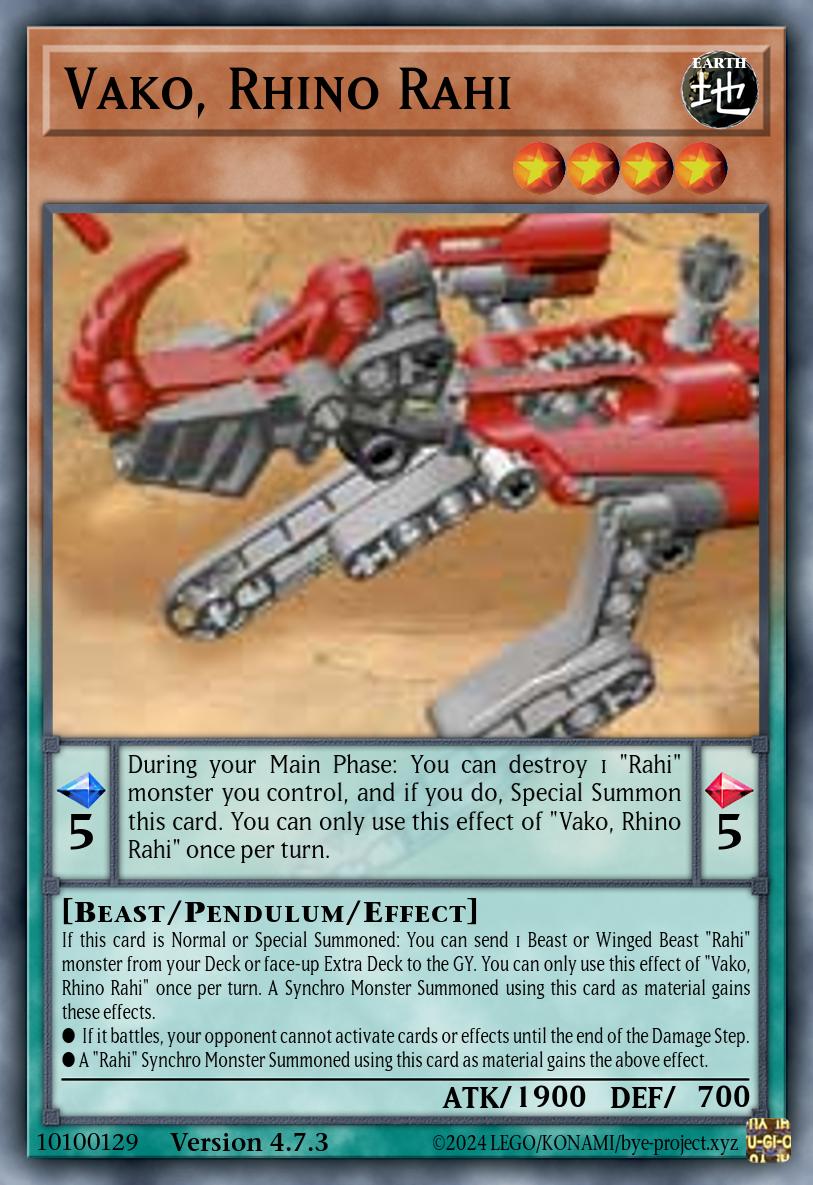
Vako, Rhino Rahi
Pendulum Effect MonsterLevel 4 | Scale 5/5 | EARTH Beast | ATK 1900 / DEF 700[ Pendulum Effect ]
During your Main Phase: You can destroy 1 “Rahi” monster you control, and if you do, Special Summon this card. You can only use this effect of “Vako, Rhino Rahi” once per turn.
—————————————-
[ Monster Effect ]
If this card is Normal or Special Summoned: You can send 1 Beast or Winged Beast “Rahi” monster from your Deck or face-up Extra Deck to the GY. You can only use this effect of “Vako, Rhino Rahi” once per turn. A Synchro Monster Summoned using this card as material gains these effects.
● If it battles, your opponent cannot activate cards or effects until the end of the Damage Step.
● A “Rahi” Synchro Monster Summoned using this card as material gains the above effect.
Much less universal, but still present in both of the EARTH decks, is the package of Beast-Type Rahi (and an itsy bitsy spider) that happens to gravitate around that Attribute. The Mahi and Ussal search or revive if they hit the GY, the Vako takes care of getting them there, and if you can find a Fikou on top you can Synchro into either a Mata Nui Cow (disruption) or a Kuma-Nui (board breaker) thanks to the magical Dikapi bridge. Or in some cases go for a Nui-Kopen (though it’s a WIND Insect) and get whatever Rahi Spell/Trap you desire. Very well-rounded lineup overall.
Decks
Presented in a particular order, but I’m not saying what it’s based on so the nerds among you can feel good about figuring it out on your own.
Ga-Koro
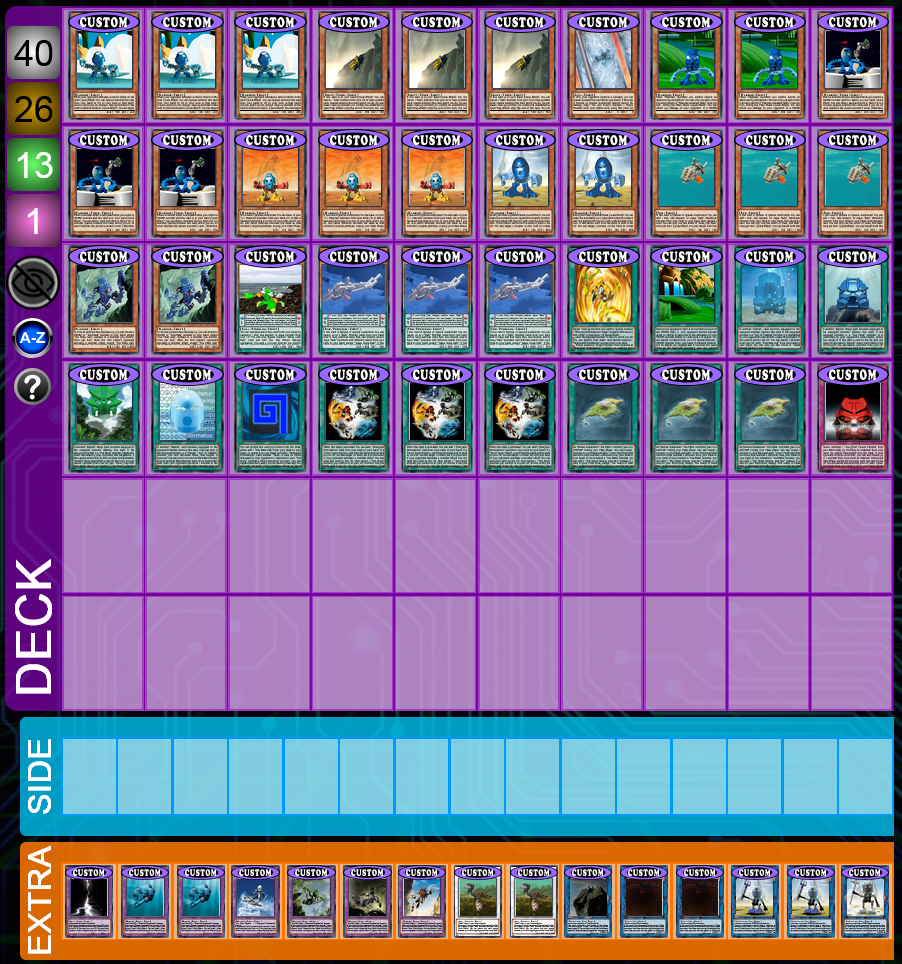
A WATER deck that aims to control the game by combining a great number of small individual monster quick effects with layers of protection and recursion to give you an edge over your opponent. Like all the villages, the inspiration for this is the principle assigned to it by MNOG2 – in this case, Purity, as represented by the primary effect of Ga-Koro , which keeps your opponent from responding to said quick effects altogether as long as you keep your GY “pure”. In practice, however, the key card of the strategy is Nokama , who takes care of most of the protection and reclaims your resources every End Phase as long as you keep her linked.
This gives us some hints as to the kind of things we want to add to this deck: Monsters with quick effects, that can put additional bodies on the field before the End Phase if need be, and are ideally purely WATER. Which ultimately brought me to the aquatic Rahi, where the Ruki acts as potent disruption with a bit of setup, and the Waikiru provides a quick tag-out to fill your monster zones as needed. They also feature the Keras crab, canonically domesticated by the Ga-Matoran and specifically written to have a bit of interplay with all those low-level WATER monsters you’ll be moving around.
Ga-Koro itself is only at a single copy in this list, and is instead accessed via Mata Nui to provide a layer of insurance. Which, I am realizing as I write this, doesn’t actually make sense because Mata Nui’s insurance policy works by searching you a second copy that we do not have. Oops. I guess you can swap the base Kaukau out for it, as you’ll see in the other decks below I soon realized the need for that mask is largely superseded by the Kanohi Nuva + Nuva Symbol combo.
Onu-Koro
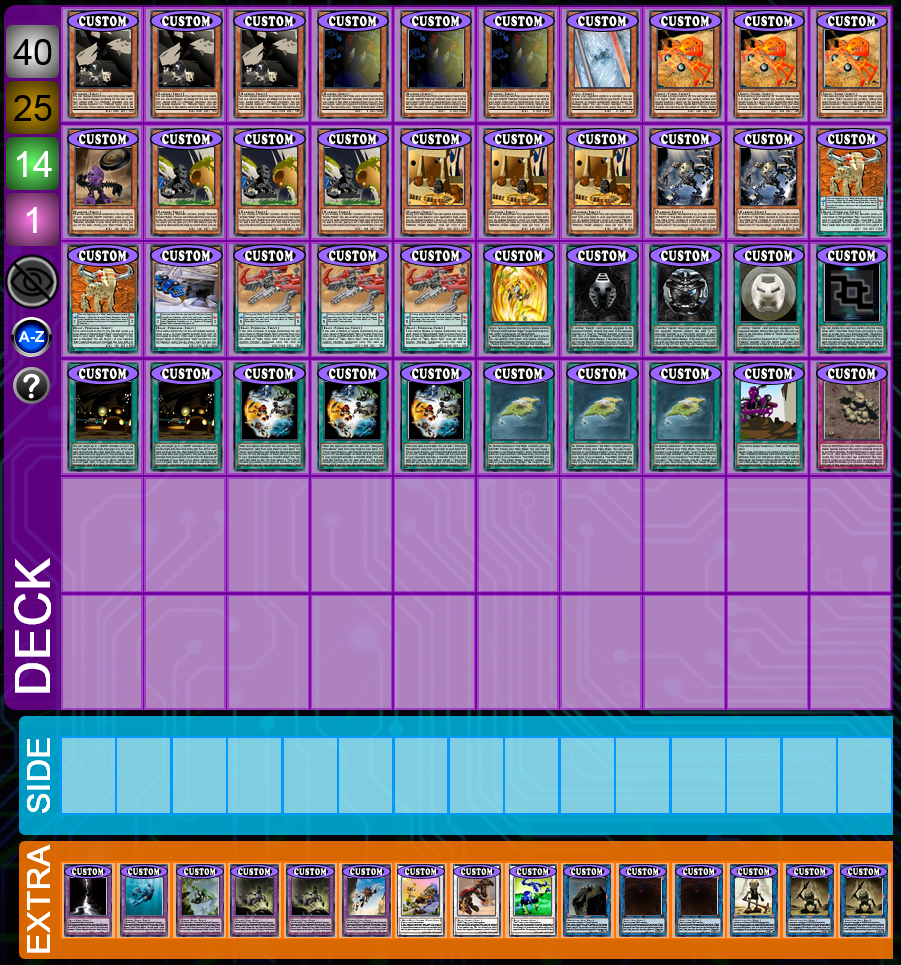
For the village of EARTH, the name of the principle is Prosperity – do hard work that piles up cards in your GY, and you shall be rewarded with a wealth of LP that can be exchanged for even more cards. That’s, in a nutshell, what the Onu-Koro Field Spell does, and this time it really is a central piece of the strategy. What you’re trying to do is build your board through combos involving lots of EARTH monsters, then when you’re done put those back, and fill your hand with a fresh new batch of resources. Or handtraps, if we’re being real, but that’s not happening with a pure build.
While the Beast Rahi package discussed above doesn’t seem to fit perfectly into this puzzle on account of largely consisting of Pendulum Monsters that avoid the GY if they can help it, they do quite consistently enable plays that end with a Synchro on the field and a few extra bits in your savings account. Plus, Onepu is in here as direct Rahi support that lets you recycle and reuse your Ussal for even more material, so it’s more or less a must-play.
Conveniently, this Attribute also has a search card for its Matoran that directly causes further GY setup: Empty Bohrok Shell , part of the Boxor series of cards I’ve otherwise elected to ignore for being too specific. Not this one though, it just discards itself to add and also pops a thing when banished, very cool. Also Ahkmou from Po-Koro is here because an extra SS from hand sure is nice with all the cards we (hope to) draw. And that odd Trap at the end there is Vatuka , the custom EARTH support card I randomly remembered exists. No it didn’t ever come up in testing, who knows if it’s useful. Probably not.
Ko-Koro
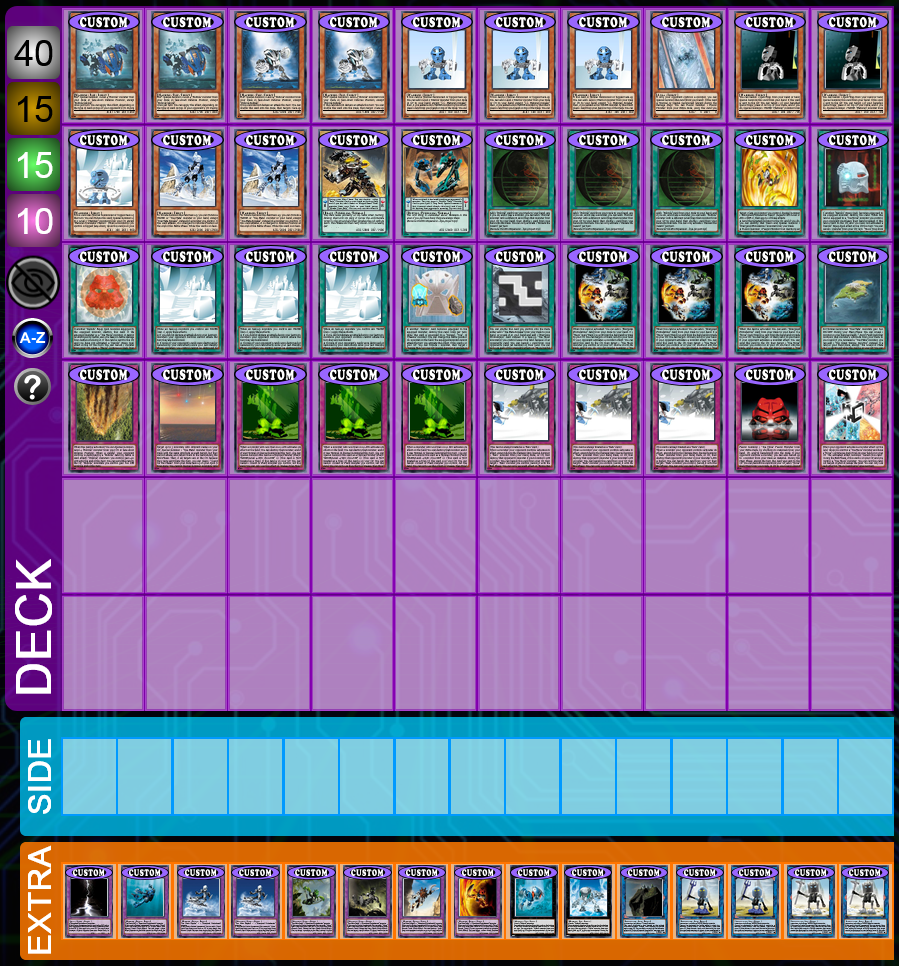
The second WATER (because there is no ICE) deck in the lineup tries to set itself apart from Ga-Koro’s monster effect craze by playing stun and avoiding monster effects during the opponent’s turn altogether. Its Field Spell Ko-Koro , based on the principle of Peace, is essentially a floodgate that derives its power from you not doing things – if you don’t attack, neither can your opponent, if you don’t destroy/banish things, neither can your opponent, and finally, if you don’t activate monster effects, your opponent’s are negated. The win condition under this philosophy is to keep your opponent locked down, use Turaga Nuju to bounce their things back while your own monsters go face-down, and then eventually flipping everything and breaking the peace for a swift lethal push. Since having Ko-Koro itself up is kind of essential and most of the deck is Spells/Traps, we run an unusual ratio of 3 village and 0 island in this case.
So, if we can’t use monsters for disruption, it makes sense that we want some Traps, and, uh, turns out there kind of ain’t any? All the ones played in “normal” Ko-Koro decks are from outside the expansion, so under the current restriction we’ll have to settle for some more questionably helpful ones: Encounter in the Drifts (for Muaka or Tarakava , the latter of which is also a “trap” if you squint) and Daikau Trap Hole from the Rahi side, and Coming of the Toa to throw in a quick Kopaka in case our opponent tries to remove something. All of these, mind you, are themselves removal and will therefore cancel Ko-Koro’s protection for the turn, but it’s not like we have a lot of options here. They also all Special Summon, which means they conflict with the, in hindsight, way too harsh restriction on Jaa’s second effect. Ugh.
The other major point of synergy to consider is all the flipping performed by Nuju. The Bohrok are, notoriously, Flip Monsters, and you can just barely squeak together a functioning engine of them from just the WATER-Attribute Gahlok and Korahk , as well as Bohrok Invasion to get them back into rotation if they don’t make it back to the Deck on their own.
… man, why are there TWO different supplemental engines consisting of villain cards in this deck? I knew we couldn’t trust Nuju, that bird-tongued lunatic.
Anyway, the Nuva package here also stands out a bit due to including BOTH Traps, fittingly enough. Both of them actually happen to offer forms of removal that sneak around the contractual terms of Ko-Koro’s own protection, since Emergence just “sends” via triggering Energized Protodermis Chamber and Overcharge makes a monster banish itself without technically getting your hands dirty.
Le-Koro
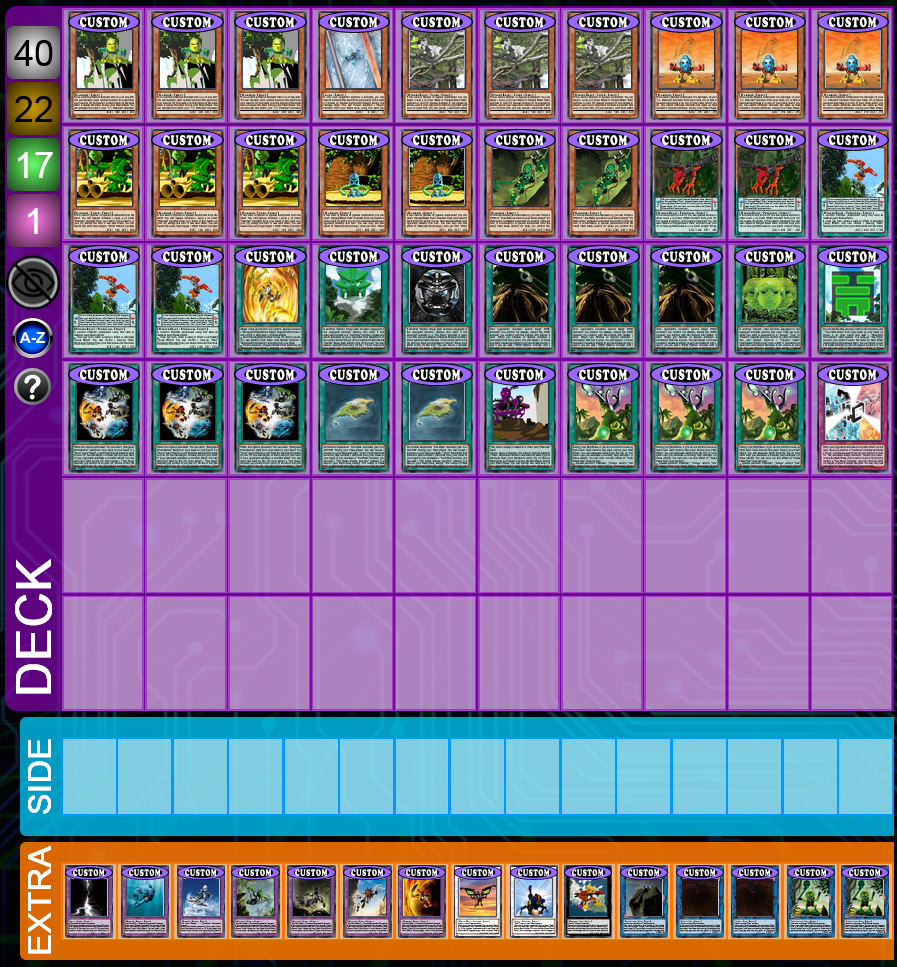
Le-Koro is a bit unique in that its Field Spell actually is a combo piece and potential starter with its Faith-based ability to add WIND Warriors from the Deck, which is why this one is played at 3 copies +2 Mata Nui. The general focus of the deck is recovery and constantly getting back your spent resources to swarm the field over and over again, until eventually you’ve chewed through all of your opponent’s hopefully more limited ammunition. Looking back, it’s a fairly modern style of gameplay compared to when this was made a few years ago.
A peculiar inclusion here is the Vuata Maca Tree , a card that should on paper be very good in any -Koro deck, but I just cannot bring myself to play due to how luck-based it is. I decided to try it in this one specifically because a) tree in the forest and b) a lot of the Le-Matoran have on-summon effects, so getting 2 or 3 of them out at once is a big payoff; it worked pretty well.
Now for the Rahi side engine of choice, we have the Winged Beasts, specifically the WIND subset of them. In a parallel to Onu-Koro, Kongu has an effect that interacts with Winged Beast Rahi and specifically helps trigger the Kewa to get something out of your GY. They also boast a Tuner with a revival ability of its own in the Mata Nui Fishing Bird , which you can use to make a Nui-Kopen or the big Gukko-Kahu , which in turn dumps another Rahi on Summon and floats into one as well. In fact, as a domesticated Rahi, it can be made with the Matoran Tuner Makani as well, which then allows you to get access to the Fishing Bird that way and make another Synchro after linking the Gukko away. Fits the spirit of Le-Koro pretty well, considering Turaga Matau also prominently features a floating effect.
Though we do kind of have a problem with those: Because Le-Koro’s search applies a WIND lock, it’s easy to get in situations where you make it to Matau and a Gukko, and then just have nothing to Link them into so their effects trigger! Amaja-Nui is still LIGHT in the Extra Deck, and making another copy of Matau requires a WIND Warrior you might not have at that point. Very annoying, but finding weaknesses like this is precisely the kind of thing I was hoping to do with this experiment.
Po-Koro
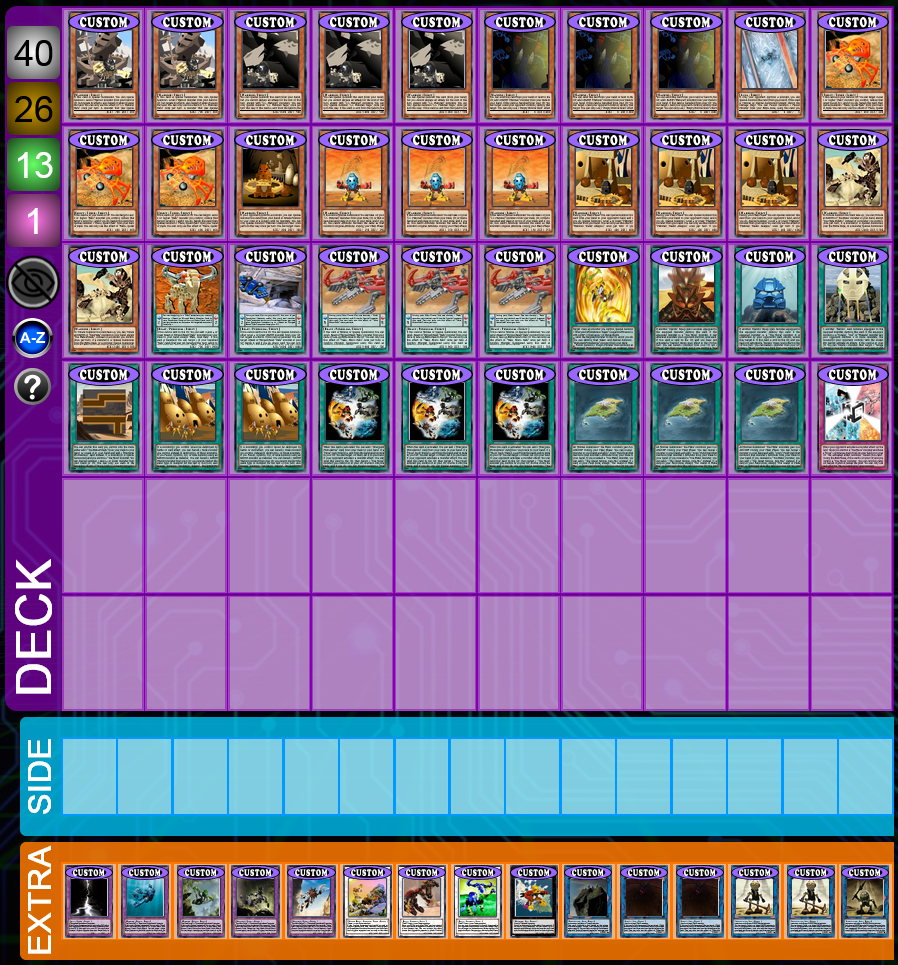
Po-Koro , the village of Stone, is in a similar position as that of Ice, in multiple ways. One is that its element isn’t an Attribute and therefore it has to share EARTH, the other is that its prinicple (Creation) causes it to be designed around a type of card it doesn’t natively contain: Extra Deck monsters. Well, there’s Turaga Onewa , but he’s supposed to kick off your combo, not be the only thing in it!
With the conceit of the Field Spell being that you build up your board using multiple different summoning mechanics, the Synchros provided by the Beast Rahi package are a helpful addition to patch over this hole. In fact, the Fikou-Nui that’s normally just a Level modulation tool has another use in this deck as an EARTH Link-1 you can Special Summon to Onewa’s zone and trigger his effect even if the only move available to you is “Normal Summon Fikou”.
Still, our access to the big boss monsters that the strategy revolves around is unfortunately limited, and, worst of all, contingent on getting our hands on a Rahi Tuner or Nuva Fusion materials. The Matoran on their own are only going to make Turaga, or maybe a Kaita Xyz, but at best that lets you wall up until you draw into the stuff you need for a proper win condition. The Tokens and destruction replacement from Po-Koro help in that sense as well, so I suppose it is a somewhat coherent gameplan, just markedly different from the balls-to-the-wall combo approach this deck takes when given full access to the card pool.
Ta-Koro
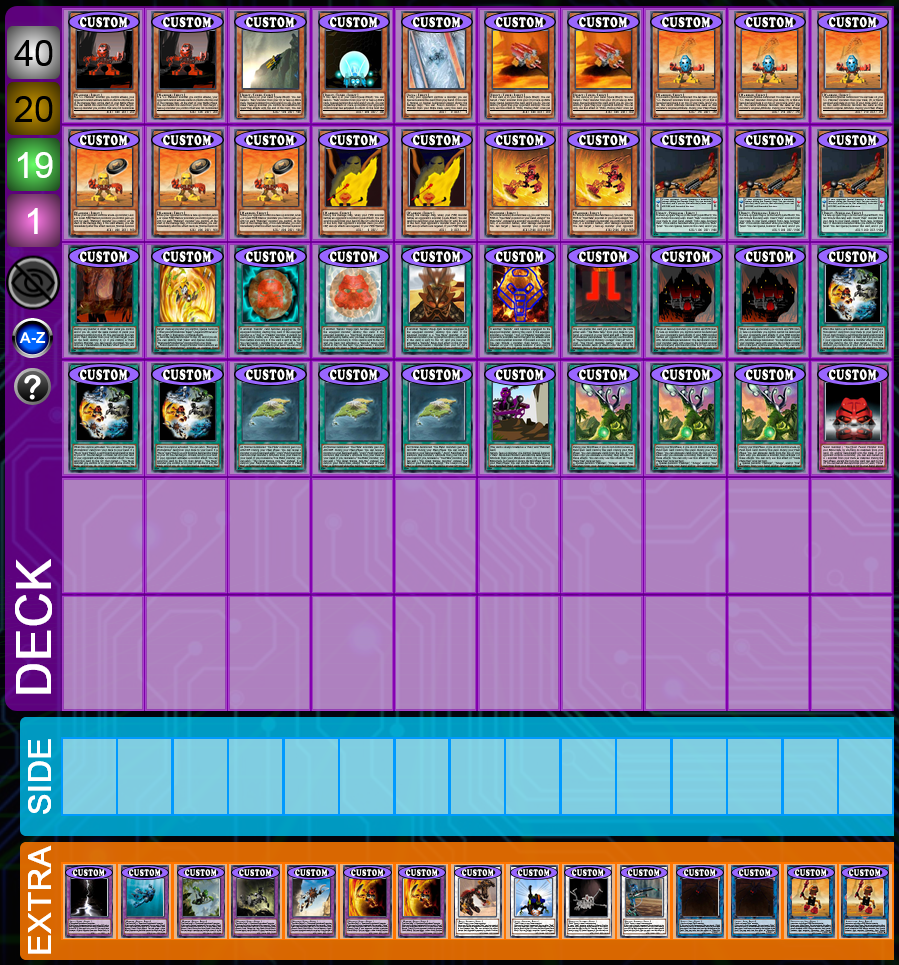
The final stop in our journey is Ta-Koro , the walled village amidst the Lake of FIRE. Its residents subscribe to the principle of Courage, and so the plan is simple: Fearlessly challenge powerful enemies and emerge victorious against all odds. It’s a beatdown/OTK deck whose gimmick is defeating monsters with high original ATK in battle for massive damage, is what that works out to.
Now if you see this description alongside the FIRE Attribute and think of Tenpai, let me get the disappointment and/or relief out of the way: I designed these long before that deck was printed, and unlike Konami, made the unfortunate mistake of showing restraint when I did so. This results in a strategy that tries to play from a disadvantageous position, and on top of that isn’t even very good at it. In practice you honestly might want to go first, hope Ta-Koro’s destruction protection helps you survive, and then try to win on turn 3 with the already present setup. I have my work cut out for me in the update with this one.
Anyway, suboptimal as the current state is, it still has a decently clear win condition it can, in theory, pull off. Quite interestingly, the Insect-Type Rahi turned out to fit in here pretty well, since their 1-card starter Kofo-Jaga is a FIRE monster and the handtrap Tuners it searches fill gaps such as disruption and backrow removal. Some of them are the wrong Attribute, but luckily this village doesn’t have any real locks (just a condition on its protection), so we can work with that perfectly fine.
Conclusion
In terms of the first question we set out to answer – “do these cards function in a vacuum?” – I think this experience lets me settle on a solid “eh, kinda”. You can definitely tell the Matoran themselves were not designed with such a scenario in mind, but since their connection points to the outside were specified very broadly via Attributes, cards like the Rahi just so happen to be the right size and shape to fill the hole left by removing all the generic support. The major problem limiting the effectiveness of these combinations is that the engines, while they work together, don’t really bridge into each other in a way that lets them play like a finely tuned modern deck, so you kind of just have to independently draw the things you need to access each of them. That’s especially annoying in cases like Po-Koro and Ko-Koro that revolve around things they just don’t provide on their own.
Overall, my feeling from testing is that the ranking of how well the decks work on their own goes something like this:
Onu-Koro > Le-Koro >> Ga-Koro > Po-Koro >>> Ko-Koro > Ta-Koro
Makes sense that the one that can draw 3 cards every turn isn’t too bothered by a lack of searchable starters; meanwhile Le-Koro actually does have a bit of search power to alleviate that issue. Ga-Koro and Po-Koro work, but feel limited by lack of generic end board pieces, and finally Ko-Koro and Ta-Koro are just cases where I may have held back too much for fear of making a toxic stun/OTK deck, respectively – they almost lose to themselves more than to the opponent.
Which brings us to question two, what to focus on for the upcoming updates? Well, giving Extra Deck monsters to Po-Koro and Traps to Ko-Koro seems like a no-brainer based on the observations above, but for further specifics you’ll just have to stay tuned. Most likely it’s going to turn out to be a mix of new cards and tweaks to old cards, removing certain cumbersome restrictions and such.
More on that front will follow soon. As in, later this year. Probably.